Ulysses S. Grant Quotes
I was assailed so bitterly that I hardly knew whether I was running for the Presidency or the penitentiary.
Ulysses S. Grant, 1822-1885, 18th President of the United States (Republican, OH), Remark after his campaign for a third term, 1880
Sourced by: Eigen's Political and Historical Quotations


After a memo was circulated about House Speaker-elect Tom Foley that implied that the congressman was a homosexual:. at the Republican National Committee, source of the offending letter


Leader of the East German Democracy Movement. Musical Director of the New York Philharmonic

At that time, most of the leading Republicans practiced negative campaigning with vicious personal attacks that were often untrue. He was the only one of the 9 candidates who did not engage in the technique. He came in close to last.

This quotation is the root of a great dilemma for all politicians who are attacked on a personal level. Most slanders are soon forgotten. The politician who reacts and publicly counters the slander inevitably does two things. More people become aware of the slanderous charges then there is a public battle over it, and the media tend to report the contest and hence the slanderous charge for a longer period of time than if it were uncontested. However sometimes the undefended charge is perceived as being true especially if it is a major charge. If the politician does not defend, the charge can get accepted and damage the politician’s standing. In the Kerry-Bush Prudential campaign, Kerry had the edge until the so-called Swiftboat Veterans made up a fictitious tale of Kerry, a decorated war hero, being a coward in the Vietnam war. Kerry thought the charge so preposterous that he didn’t bother to defend it. His lack of reaction was taken by much of the public as his admission of the charge. Kerry’s hero image was destroyed by a large enough proportion of the electorate that the electoral votes shifted to Bush, even though Kerry had the most votes by far. For each politician, the decision must be made for each charge and there is no clear way to know in advance which is the better strategy when a false charge is made.


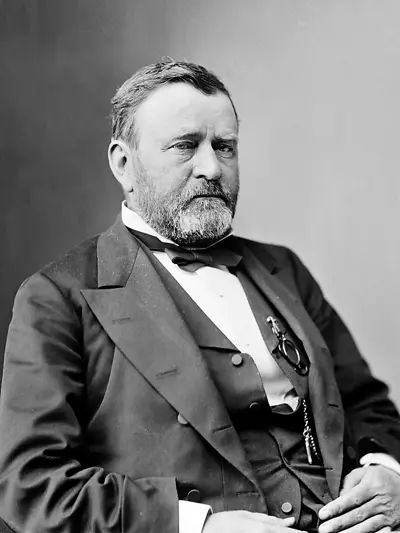
Ulysses S. Grant was an American military leader who served as the 18th president of the United States from 1869 to 1877. As president, Grant was an effective civil rights executive who created the Justice Department and worked with the Radical Republicans during Reconstruction to protect African Americans. As Commanding General, he led the Union Army to victory in the American Civil War in 1865 and thereafter briefly served as Secretary of War.
