Rand Paul Quotes
I want to collect more records from terrorists, but less records from innocent Americans. The Fourth Amendment was what we fought the Revolution over! John Adams said it was the spark that led to our war for independence, and I'm proud of standing for the Bill of Rights, and I will continue to stand for the Bill of Rights.
Paul, Rand. "Fox News Republican Presidential Debate." Fox News, 6 Aug. 2015.


There has in the United States, since the Constitution was ratified, a tension in every war or conflict, where some Americans wanted to reduce civil rights in order to better cope with the conflict and others observed that what we were fighting for is precisely those civil rights and liberties. John Adams and the Federalists, did not want anyone to be allowed to publicly criticize the Government while we were in conflict with Great Britain. They passed the Alien and Sedition Acts. Thomas Jefferson and the Republicans felt that that the freedom should not be given up in the name of national security—we could prevail without that incursion on rights. They repealed the Adams laws. In WWI, Democratic President Woodrow Wilson wanted to jail anyone who claimed that the military draft was improper, immoral or illegal, and he did. Republicans, when they assumed office, then released the prisoners and restored freedom of speech. In the war on terror, most Republicans like sessions, wanted to torture prisoners, allow the imprisonment of suspected terrorists indefinitely without any charges or trial, and bug American telephone calls without the usually required court warrants. Democrats disagreed. That stimulated Sessions statement.


Originally it was published in Boston under the name “A Columbian Patriot.” This was written before the Bill of Rights had been added. Criticism like this led to their addition by Congress in order to obtain ratification.


Senator Church was the chairman of the committee. It’s reports (14 in all) are the most extensive documentation of U. S. intelligence ever compiled.


Snowden, was a contract worker for Booz Allan assigned to the National Security Agency (NSA). He felt that some of the NSA activities were illegal and unethical and tried to complain to NSA officials who rebuffed him. Despite the fact that he had signed an agreement not to do so, he copied many critical, classified documents that exposed much of the NSA activities that the NSA officials had denied existed—including lying under oath to the Senate. He then made many of them public, violating his oath, breaking the law, and opening up an entire area of government spying which most Americans knew nothing about and about which senior government officials had lied under oath to Congress. They of course wanted to prosecute Snowden who had told the truth, while they had lied. For many Americans, this became a moral and ethical conundrum.

Goldsmith headed the Justice Department Office of Legal Counsel—the office that makes legal opinions to guide the Federal Government’s conduct. The George W. Bush White House had decided that the War on Terror required spying on American citizens under certain circumstances but the existing laws required that in each case, they obtain a warrant from a special FISA (Foreign Intelligence Surveillance Act) Court. They were afraid that the court might not grant the warrants in all cases so in some cases ignored the requirements to go through the court. Addington and some other White House staff felt that if there was one more terrorist incident in the United States, they could pressure Congress into getting rid of the FISA court.


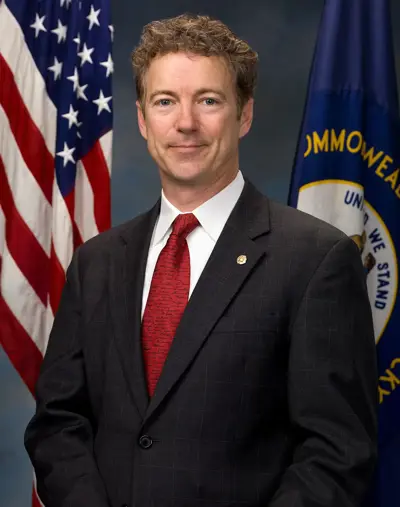
Randal Howard Paul is an American physician and politician serving as the junior United States Senator from Kentucky since 2011. He is the son of former three-time presidential candidate and twelve-term U.S. Representative of Texas, Ron Paul.
