Ron Paul Quotes
I want to be president mainly for what I don't want to do: I don't want to run your life, I don't want to run the economy, and I don't want to police the world.
Paul, Ron. 2012 Presidential Campaign Speech.


See the John Birch Society for a similar notion.


This quotation is very critical to people interested in the Libertarian party and libertarian movements. Although she literally “loathed” the libertarians of the day, almost all modern libertarians credit the modern libertarian movement have not only started with her but even into the 21st century she is acknowledged to be the largest intellectual force of libertarianism. Actually, she was a very strong person with very firm ideas, and she was criticized by some people who called themselves libertarian and did not follow her philosophy of individual responsibility and liberty. Her reaction was not only to avoid identifying with them but to differentiate herself whenever she could.


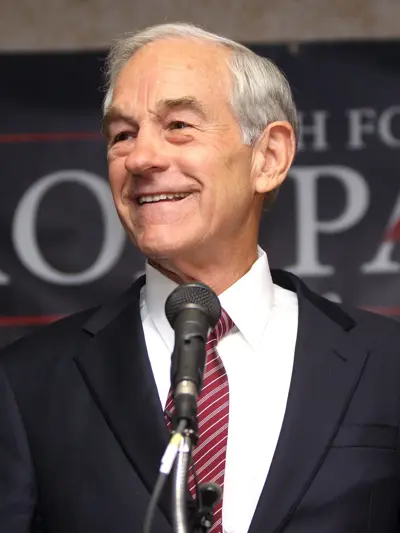
Ronald Ernest Paul is an American author, physician, and retired politician who served as the U.S. Representative for Texas's 22nd congressional district from 1976 to 1977 and again from 1979 to 1985, and for Texas's 14th congressional district from 1997 to 2013. On three occasions, he sought the presidency of the United States: as the Libertarian Party nominee in 1988 and as a candidate for the Republican Party in 2008 and 2012. A self-described constitutionalist, Paul is a critic of the federal government's fiscal policies, especially the existence of the Federal Reserve and the tax policy, as well as the military–industrial complex, the war on drugs, and the war on terror. He has also been a vocal critic of mass surveillance policies such as the USA PATRIOT Act and the NSA surveillance programs. He was the first chairman of the conservative PAC Citizens for a Sound Economy, a free-market group focused on limited government, and has been characterized as the "intellectual godfather" of the Tea Party movement, a fiscally conservative political movement that is largely against most matters of interventionism.
