Stanley A. McChrystal Quotes
I want the American people to understand, we have a clear and focused goal: to disrupt, dismantle and defeat Al Qaeda in Pakistan and Afghanistan.


Although the President was personally opposed to terrorism and his policies opposed terrorism, in his country most people supported terrorism and the Islamic schools—madrasas—taught intolerance, hate and terrorism. Even leading generals of the army were major supporters of terrorism. See {586700} as an example.


The Pakistani Intelligence Service and the Pakistan Army were never under the control of the civilian government which wanted an alliance with the United States in the War on Terror. However, the Pakistani military and especially their intelligence service (ISI) wanted the support of Al Qaeda and the Muslim religious extremists in Pakistan in their endless crusade against India. The Afghanistan Taliban could not sustain their attacks if they were not given sanctuary, weapons, and supplies over the border in Pakistan, This was arranged and given the go ahead by the ISI. Holbrooke, with American responsibility for BOTH Afghanistan and Pakistan speculated that the war in Afghanistan would end if we attacked the Pakistani ISI and blocked their supply and sanctuary activities, hence the quotation. “The Wrong Enemy” was taken from this quote by Carlotta Gall in her book in the role of Pakistan in the Afghanistan War.


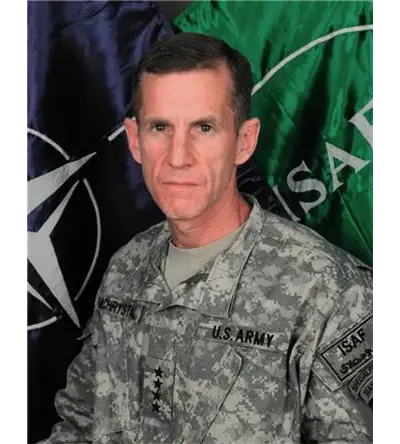
Stanley Allen McChrystal is a retired United States Army general best known for his command of Joint Special Operations Command (JSOC) in the mid-2000s. His last assignment was as Commander, International Security Assistance Force (ISAF) and Commander, United States Forces – Afghanistan (USFOR-A). He previously served as Director, Joint Staff from August 2008 to June 2009 and as Commander of JSOC from 2003 to 2008, where he was credited with the death of Abu Musab al-Zarqawi, leader of Al-Qaeda in Iraq, but also criticized for his alleged role in the cover-up of the Pat Tillman friendly fire incident. McChrystal was reportedly known for saying what other military leaders were thinking but were afraid to say; this was one of the reasons cited for his appointment to lead all forces in Afghanistan. He held the post from June 15, 2009 to June 23, 2010.
