Zhang Zhidong Quotes
I understand that the tendency of foreign countries in recent years has been to establish particularly close relations with one or two others among all the countries which have general relations. In time of peace, they make secret treaties in advance, and in wartime, they aid one another with military provisions and armaments.
Zhang, Zhidong. Quanxue pian. Hubei Guan Shuju, 1898.

Shortly thereafter the United States joined the allies and the First World War.


The Spanish had been beaten and bloodied by England, but no one else until Napoleon would come along later. So it was easy for Spain to bully and dominate the non-English countries.

See {640831} for more on this subject.


In a NATO military operation, there is one NATO Supreme Commander but each nation has a minister for NATO. All significant decisions must be consented to be this group. But each of those is a representative of a different political government. Clark was masterful at this diplomatic side of the war just as Dwight Eisenhower was in WWII. Eisenhower had bigger egos to content with—Churchill, Roosevelt, Stalin, De Gaulle, but Clark had many more counties who could each veto actions.


He was shot as a traitor when de Gaulle returned. See {587231} and {587230}.


Inscribed in the John Adams Building of the Library of Congress. On this subject Jefferson was in agreement with George Washington {37176} and his political opponent, John Adams {592705}.

The “entangling alliances” phrase was first used by Thomas Jefferson in his First Inaugural Address. He had been Secretary of State in George Washington’s cabinet. The phrase is often misattributed to Washington. The sentiment was definitely his also however.


The “gentlemen: were 4 ultraconservative members of Congress who objected to our sending surplus food to India when they had a terrible famine. India was “non-aligned” in the Cold War and the Congressmen did not want to send them food unless they allied with us against the Russians. India was a fledgling democracy at the time and was vulnerable to bad weather and crop failure. Once, our food helped them get on their feet, they improved their agricultural production and today they have sufficient food stored so that they can survive major agricultural crises.

She was explaining the general American’s hostility toward diplomacy.
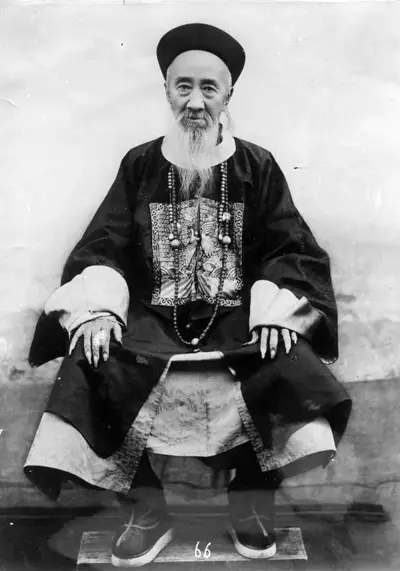
Zhang Zhidong (Chinese: 张之洞) was a Chinese official who lived during the late Qing dynasty. Along with Zeng Guofan, Li Hongzhang and Zuo Zongtang, Zhang Zhidong was one of the four most famous officials of the late Qing dynasty. Known for advocating controlled reform and modernization of Chinese troops, he served as the Governor of Shanxi Province and Viceroy of Huguang, Liangguang and Liangjiang, and also as a member of the Grand Council. He took a leading role in the abolition of the Imperial examination system in 1905. The Red Guards destroyed his tomb in 1966 during the Cultural Revolution. His remains were rediscovered in 2007 and reburied with honors.
