Andrew Jackson Quotes
I trust in due time to lay the perfidy, meanness, and wickedness of [Henry] Clay naked before the American people. I have lately got an intimation of some of his secret movements, which, if I can reach with positive and responsible proof, I will wield to his political, and perhaps his actual, destruction.
Jackson, Andrew. Correspondence of Andrew Jackson. Edited by John Spencer Bassett, vol. 3, Carnegie Institution of Washington, 1928, p. 276.

After a memo was circulated about House Speaker-elect Tom Foley that implied that the congressman was a homosexual:. at the Republican National Committee, source of the offending letter
_0_PostageStamp_47x47.jpg "Chairman of the Joint Chiefs of Staff Navy Adm. Mike Mullen gives an interview to John Dickerson during the CBS news program Face the Nation in Washington, D.C., July 5, 2009. During the interview, Mullen discussed the wars in Iraq and Afghanistan, North Korea's recent missile tests and his recent visit to Russia. (DoD photo by Mass Communication Specialist 1st Class Chad J. McNeeley, U.S. Navy/Released)")


In 1934 writer Upton Sinclair won the California Democratic gubernatorial nomination. The Republicans spent three times the funds that they had committed against Roosevelt in the 1932 presidential election to defeat Sinclair. In particular, they used the first "media consultants" in American political campaigns to comb through all of Sinclair's novels finding dialogue of the villains which were then ascribed to Sinclair in a series of cartoons distributed throughout the state:
For a similar view of Nixon, see Nikita Khrushchev.

At that time, most of the leading Republicans practiced negative campaigning with vicious personal attacks that were often untrue. He was the only one of the 9 candidates who did not engage in the technique. He came in close to last.

The memo proposed having a good novelist write a fictional novel with Nixon as the main character. The great Nobel Laureate John Steinbeck was approached for the project. See {629628} for his reaction.


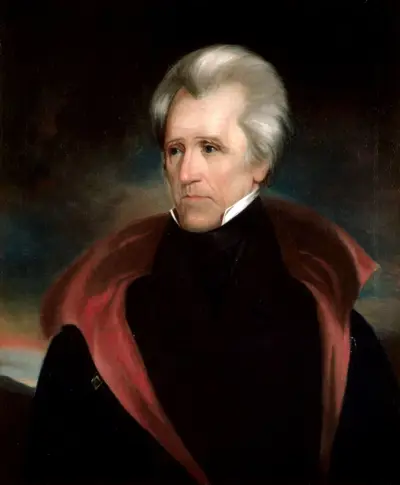
Andrew Jackson was an American lawyer, soldier, and statesman who served as the seventh president of the United States from 1829 to 1837. Before being elected to the presidency, Jackson gained fame as a general in the United States Army and served in both houses of the U.S. Congress. An expansionist president, Jackson sought to advance the rights of the "common man" against a "corrupt aristocracy" and to preserve the Union.
