Woodrow Wilson Quotes
I think that I … should be able to help restore the Holy Land to its people
Wilson was a descended from a line of fundamentalist Presbyterian Ministers who believed firmly that God ordained the Holy Land for the Jewish People. Even though the WWI peace was the main topic of the Versailles Treaty negotiations, because the Turks made the poor judgment to ally themselves with the Germans and the Ottoman Empire was to be broken up. There was much lobbying by Zionists of many countries and many Arab groups even then.
Woodrow Wilson, 1856-1924, 28th President of the United States (Democrat, NJ), Quoted in Michael Oren, “The Ultimate Ally”, Foreign Policy, May / June 2011
Sourced by: Eigen's Political and Historical Quotations


This famous quotation, from this important address, at such a critical time in history has been admired for years. Despite his great oratory, the next months were to see almost 2 million Indians of all faiths killed in what was probably the worst internecine violence in human history. Ironically, the politically motivated terrorism had stopped since all the decisions had been made. The motivation for the frightful atrocities that took place from then on was vengeance and fear of more vengeance." 1st Earl Mountbatten of Burma

The pre WWII Zionists who returned to the Holy Land brought with them, the education, culture, technology, and particularly the modern scientific methods of agriculture and irrigation. The Arabs lived the same way as they had done since 1100 when the Muslim world "closed" to new ideas and change. At that earlier time, the Arabs had the advanced agricultural techniques which Europeans copied throughout Spain and Italy. While advanced for 1100, Arab agriculture was backward by early 20th century standards. Arab farms could mostly just feed the land owning family and produced little surplus, and they wasted huge amounts of water in the process. The returning Jews assumed that the Arabs would welcome these new techniques as well as the public health, medicine, engineering and science. They thought that they were bringing great gifts to the non-Jewish inhabitants of the land. However, even though the Jewish farms improved the quality of the produce and increased the productivity many times with much less water needed, for the most part, the Arabs would not depart from their traditions and religious dictates. One of the reasons Islam had been so successful in its inception was that it prescribed behavior in every phase of life, not just religious. But then it became very difficult to change. So the benefit that the Zionists thought that they were bringing back to the Middle East were not seen as benefits by the Arabs whose various cultures and countries have remained religiously and tradition bound even into the 21st century.


Mohamed Anwar El-Sedat


Husayn Ali Nuri

In the complicated and arcane Middle East, substantial majorities of Israelis and Palestinians both favored a two state solution, thus creating a Palestinian State out of the West Bank and Gaza. However, the Hamas terrorist organization won the majority of seats in the Parliament and formed the “government” of the Palestinian Authority. Hamas opposed Israel’s right to exist at all, as that position as well as virulent Anti-Semitic threats to all Jews in the world. Many called for Hamas to change their charter and crease their opposition to the right of Israel to exist. The President of the Palestinian authority called for new elections but Hamas refused. Thus Blair and other diplomats the world over were in a very difficult situation.


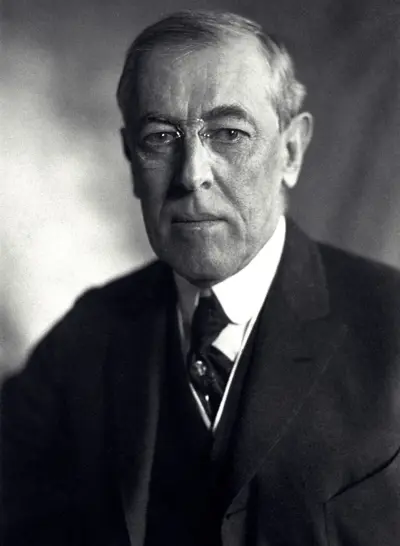
Thomas Woodrow Wilson was an American politician and academic who served as the 28th president of the United States from 1913 to 1921. A member of the Democratic Party, Wilson served as the president of Princeton University and as the 34th governor of New Jersey before winning the 1912 presidential election. As President, Wilson led the United States into World War I in 1917. He was the leading architect of the League of Nations, and his progressive stance on foreign policy came to be known as Wilsonianism. Scholars have generally ranked Wilson in the upper tier of U.S presidents, although he has been criticized for supporting racial segregation and white supremacy.
