Theodore Roosevelt Quotes
I should have appointed a judge with more backbone than a banana.
He had recently appointed Holmes to the Court who then ruled against the President on a case.
Theodore Roosevelt, 1858-1919, 26th President of the United States (Republican, NY), Statement about Supreme Court Justice, Oliver Wendell Holmes
Sourced by: Eigen's Political and Historical Quotations

While the Southerners, and Northern Democrats accused Lincoln of precipitous, hasty and radical actions, radicals of his own party were not happy with him as he didn't move fast and firmly enough.

Some scholars believe that it was Henry Cabot Lodge to whom he made this remark.


Bush was Reagan’s Vice President, but had little influence on top level appointments. Bush would have been particularly helpful with this appointment as he had previously served as a very successful CIA Director. Others also disagreed with this Regan appointment. See {637469}. See {637470}, {613419} and {623500} for Casey quotes that support Bush’s judgment

1st Earl of Beaconsfield

See Cordell Hull quotation, June 21, 1945

See Abraham Lincoln for a similar view.
Roosevelt was then one of the 3 Civil Service Commissioners of the Harrison administration.


The issue of how the federal judiciary would be selected was one of the more hotly debated issues during the Constitutional Convention.


First woman to receive the British Order of Merit. Nightingale was a great and prolific writer, and nothing attracted her ire worse than bureaucracy. See {614057}.


Webb’s opponent had accused him of not being patriotic because he opposed many of President George W. Bush’s Iraq War policies. This technique of publicly intimating that an opponent was not patriotic because he opposed the hawkish proposals of the President, had worked very well for the Republicans before. Presidential Candidate John Kerry, a decorated war hero, was attacked and remarkably Senator Max Cleland who had lost three of his four limbs in battle was unseated by attacking his patriotism. When Senator George Allen, fighting for reelection, used the technique on Webb, Web responded much more aggressively than earlier Democrats had when faced with the accusation. Senator Allen, like most of the patriotism critics of heroic veterans, had never been in combat.

Armstrong rarely commented on politics (see {615854}), but the Governor defying the Supreme Court and not letting his people even go to school with other students was too much for him. He not only made the statement, but he approved it for publication. This shocked many who knew him as an apolitical person. He was particularly distressed with President Eisenhower who although he had warned Faubus that he would enforce the court order and then used federal troops to do so, Eisenhower was a man of action and not rhetoric and his lack of firm public statements overlooked an opportunity to use the Presidential “bully pulpit” and exercise his moral leadership and authority. Many then, and even 50 years later, were not sure where he stood on the issue of school desegregation.

We could change the name of the President to any of the last 4 and change the issue to entitlements, and this would appear to be a modern editorial criticizing politicians of both parties for a lack of courage and failure to face significant critical issues. Henry Clay tried to forge a political compromise, but he was alone among the politicians for even dealing with the issue. The photo is of the Taylor Cabinet, none of whom offered any leadership on the slavery issue that was tearing the country apart,
In modern times, many have complained at the disrespectful way critics refer to the president of the United States. The long for the civility of the past. As this editorial shows, uncivil criticism of the president is nothing new.

Kennedy’s pro Nazi and pro Hitler stance and statements when Ambassador to England, destroyed him politically in the United States. However, we transferred his political ambition to his sons, and JFK became the first Catholic President of the United States.

This was more than a general observation at the time. Elena Kagan had just gone through difficult and extended Senate confirmation hearings to be a Justice of the Supreme Court. She was confirmed but there was a substantial Conservative opposition to her on the grounds that she had not served as a judge, although she had appeared as an attorney in many cases and as Solicitor General of the United States she argued cases before the Supreme Court. To many it was surprising that a sitting justice would so currently take a public position which could be interpreted as criticizing one wing of Congress, especially since that wing had been criticized for just playing petty politics and having no real substantive issues.

Hooker made some very poor decisions as far as Lincoln was concerned.
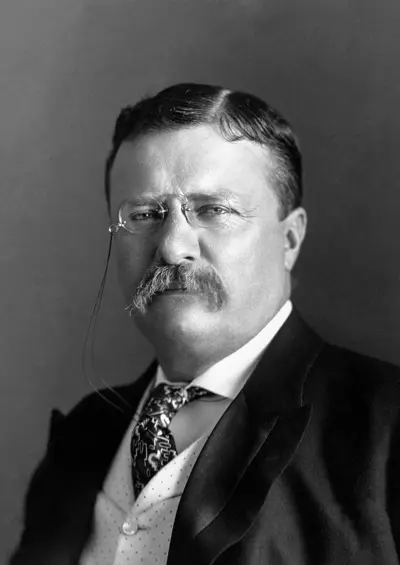
Theodore Roosevelt Jr., often referred to as Teddy or his initials T. R., was an American statesman, conservationist, naturalist, historian, and writer, who served as the 26th president of the United States from 1901 to 1909. He previously served as 33rd governor of New York from 1899 to 1900 and the 25th vice president of the United States from March to September 1901. Roosevelt emerged as a leader of the Republican Party and became a driving force for anti-trust and Progressive policies.
