Donald Cargill Quotes
I say, traitors; as some men live upon the reward of treachery, for their quiet and liberty; if it may be called a liberty, as it is redeemed with the betraying of the interest of Christ, and the blood of His people.
Cargill, Donald. "The Last Speech and Testimony of the Rev. Mr. Donald Cargill." A Cloud of Witnesses for the Royal Prerogatives of Jesus Christ, edited by John H. Thomson, Johnstone, Hunter, & Co., 1871.


Before the 1968 election, President Johnson, and gotten the North Vietnam Communists to agree to Peace Talks with the U. S. and South Vietnam. Then Candidate Nixon thought that if the peace talks were ongoing and making progress, there would be more support for the Democrats and Nixon's opponent Hubert Humphrey. So Nixon secretly send a secret emissary to South Vietnamese President Nguyen Van Thieu telling him that he would not get a very good deal because President Nixon claimed that President Johnson was too eager to end the Vietnam war. He suggested that if Thieu boycotted the peace talks, then when Nixon was elected, he would guarantee a much better deal for South Vietnam and Thieu personally. President Thieu boycotted the peace talks and there could be no progress. However there is a Federal Law, the Logan Act, that makes it a felony for a private American citizen to conduct or interfere with foreign policy or negotiations with a foreign government. President Johnson found out about Nixon—s sabotage of the Peace Talks, called Nixon and threatened him with prosecution if he interfered further. LBJ had decided that with the left wing at odds with the U. S. Government over the Vietnam War, a prosecution of Nixon would cause the Right Wing to challenge the government also and the country didn—t need further polarization. He would do that only if Nixon did not heed the President—s warning. But when Nixon won the election and became President, he was terribly anxious that his pre-election crimes would be made public, and spent much of his time and staff effort trying to find out who knew about his politically self-serving felony and who might make his crime public. See {583264}.

President Clinton had engaged in sex with an intern in the Oval Office and lied about it in investigations. Clinton had been an embarrassment anathema to the Republicans by producing a remarkably strong economy without cutting taxes, reducing government deficits, cutting the size of government, winning the Serbian war without a single American soldier dying, and preempting many of their programs. So the Republicans who controlled both Houses of Congress decided to impeach Clinton for the lies. Wexler argued that there was no damage done to the nation and the sex and lying did not rise to the required level of an impeachable offense. On a party line vote, Clinton was impeached, but the Republicans could not even get the majority of the Senate which they controlled. Most senators agreed with Wexler. See {583801} for a later summary of the absurdity of impeaching Clinton who left office as one of the most popular presidents in modern times.

“Lord Haw Haw” was the name that he used in his propaganda broadcasts from Germany to England. Despite the fact that the broadcasts were anti-British and pro German, many in Britain listened to him regularly. He was very witty and many of his criticisms of British society were views held by many patriots in Britain. As pure entertainment, he was better than most of the BBC broadcasts during WWII. At the end of the war, Joyce was captured, tried and executed for treason.

Commenting on a former CIA agent's defection to Russia:


Ingersoll was considered to be the greatest orator and political thinker of his day, but his overt atheistic views curtailed his elected political career.

Paine had been imprisoned in France for his political writings. After inspiring the nation in the Revolution, he was not a very popular figure in America, being regarded as an atheistic, rabble-rouser. The President distanced himself from the situation and did nothing to secure Payne's release.

Harrison, then a young Captain, was concerned about the French, British and Spanish agents "plotting" in the United States:


In the 1912 Republican nominating convention, Theodore Roosevelt was contesting the renomination of President William Howard Taft whom he had originally picked as the Republican nominee four years earlier. Then Senator Harding gave the nominating speech for Taft. In it he described Roosevelt as:
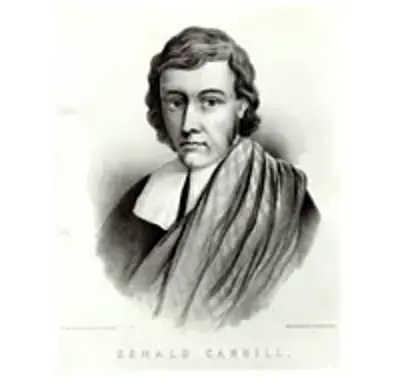
Donald Cargill was a Scottish Covenanter who worked to uphold the principles of the National Covenant of 1638 and Solemn League and Covenant of 1643 to establish and defend Presbyterianism. He was born around 1619, and was the eldest son of Laurence Cargill of Bonnytoun, Rattray, Perthshire, a notary public, and Marjory Blair. He was educated perhaps at University of Aberdeen and at the University of St Andrews, where he matriculated as a student of St Salvator's College in 1645. He was licensed by the Presbytery of St Andrews on 13 April 1653 and was ordained in 1655. He was later deprived by the Privy Council, on 1 October 1662, for disobeying the Act of Parliament in not keeping a day of thanksgiving for His Majesty's Restoration, and not obtaining presentation and collation from the archbishop before 20 September. He was ordered at the same time to remove beyond the Tay before 1 November under penalties. Disregarding this sentence, he was charged to appear before the Council on 7 January 1669, and appointed to continue in his confinement, but on petition he was allowed to visit Edinburgh about law affairs. He refused an indulgence at Eaglesham on 3 September 1672. On 16 July 1674 a decreet was passed against him for holding conventicles. In 1679 he joined Richard Cameron in founding the Cameronians (afterwards the Reformed Presbyterians), who embodied their principles in a Declaration at Sanquhar, on 22 June 1680, disowning the king's authority. A reward of 3000 merks was offered for his apprehension, dead or alive. For excommunicating at Torwood in September 1680 Charles II., James, Duke of York, and others, the Privy Council increased the reward to 5000 merks. After numerous hair-breadth escapes he was apprehended at Covington Mill, Lanarkshire, during the night of 12 July 1681 by a party of dragoons led by James Irving of Bonshaw (who got the reward). Tried for treason before the High Court of Justiciary, he was found guilty, and executed at the Cross of Edinburgh with four others [Walter Smith, William Cuthil, William Thomson, James Boig], 27 July 1681. His forfeiture was rescinded by Act of Parliament 4 July 1690. He married Margaret (died 12 Aug. 1656, within a year and a day of their marriage), daughter of Nicol Brown, burgess of Edinburgh, widow of Andrew Bethune of Blebo.
