Ralph Bunche Quotes
I say to Governor Wallace, no American can ever be an outsider anywhere in this nation.
Wallace had castigated civil right protesters coming to Alabama as “outsiders.”
Ralph Bunchee, 1904-1971, U. N. Undersecretary General, Nobel Laureate in Peace, Speech, Selma, AL, 1965
Sourced by: Eigen's Political and Historical Quotations


When asked whether a rally in Dallas for President Harry Truman was integrated


The Southern authorities were particularly angry with people form the North coming South to demonstrate over unconstitutional and immoral segregation laws. Northerners were considered as having no business with Southern desegregation. Mrs. Peabody, and the wives of a number of wives of Christian Bishops, black and white, went to a restaurant in St. Augustine and requested service which was contrary to the segregation laws of Florida at the time. The women were arrested. The act of civil disobedience in integrating the restaurant was one act of a planned desegregation strategy worked out with Martin Luther King’s SCLC organization. The mature age of the women and their prominent husbands brought a great deal of newspaper coverage which is just what the demonstrators wanted. The photo is of Mrs. Peabody getting arrested. See {637404} and {637406} for more on this incident.
The Quakers were in the forefront of not only the abolition of slavery but of the integration of the races.


France had been hit with repeated riots of Muslim and African French citizens and immigrants. Thousands of cars were burned, property damaged and violence of the protesters had injured and killed bystanders. The major complaint was that they were not really accepted as equals in French society. Chirac tried to calm the rioters and prevent a backlash. Although France was a pioneering country in acceptance and tolerance of people of different races and religions, there has always been a strong intolerant segment of French Society that were racist, anti-Semitic and Fascist leaning. Because of the French concept of equality, affirmative action was not legally possible in France so that there was heavy discrimination and even segregation in housing, schools, occupations, and socially. Further, one of the traditional expectations of all immigrants who become French is that they adopt the French language and culture. Like immigrants throughout the world at the end of the 20th century, French immigrants often wanted to maintain their own customs, culture and language—a practice which set them at odds even with otherwise nondiscriminatory Frenchmen and women.


At the time, the Southern segregationists were all Democrats and they blocked any Democratic attempt to pass any Civil Rights legislation. When he could not get a Civil Rights commitment from his own party, Powell turned to the Republicans and the President wrote this letter. In return, in November, Powell endorsed and supported Eisenhower instead of Stevenson, his own party’s nominee. Eisenhower could not get any legislation on Civil Rights as the Southern Democrats would always block it. When President Lyndon Johnson finally forced the 1963 Civil Rights Act through the Congress, the racist Southern Democrats cut a deal with Goldwater and the conservative Republicans, and switched parties. Since then the Civil Rights stance of the two parties reversed. The Democrats were thereafter pro Civil Rights and the Republicans, the party of Lincoln and Reconstruction, thereafter reversed their Civil Rights position and opposed progress in this area.

In 1968 Carlos and Tommie Smith had won an Olympic track medal, and while standing on the ceremonial medal stand they each raised a black-gloved fist in a Black power salute as the Star Spangled Banner was played and the American flag was raised. The scene was televised around the world. See {620084} for Smith’s statement about the protest.


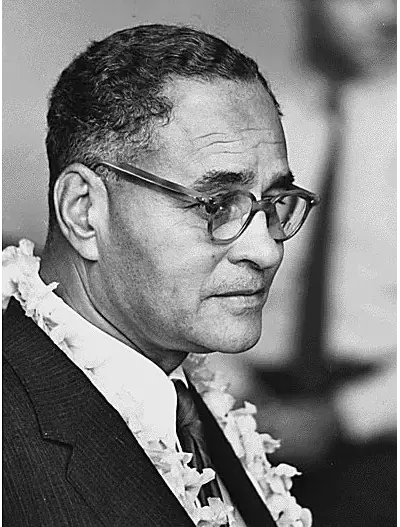
Ralph Johnson Bunche was an American political scientist, diplomat, and leading actor in the mid-20th Century decolonization process and US civil rights movement, who received the 1950 Nobel Peace Prize for his late 1940s mediation in Israel. In the List of black Nobel laureates he is the first African American and first person of African descent to be awarded a Nobel Prize. He was involved in the formation and administration of the United Nations and played a major role in both the decolonization process and numerous peacekeeping operations sponsored by the UN. In 1963, he was awarded the Presidential Medal of Freedom by President John F. Kennedy. At the UN, Bunche gained such fame that Ebony magazine proclaimed him perhaps the most influential African American of the first half of the 20th Century and "[f]or nearly a decade, he was the most celebrated African American of his time both [in the US] and abroad."
