Abraham Whipple Quotes
I received orders from Congress to proceed to Charleston in South Carolina, for the purpose of Co'operating with General Lincoln in the defense of that Capitol.
Whipple, Abraham. "Memorial to Congress." Biographical and Historical Memoirs of the Early Pioneer Settlers of Ohio, by Samuel P. Hildreth, H. W. Derby & Co., 1852, p. 156.

he always called him by his first name The name Mad Anthony Wayne stuck.


This appears to be one of the first uses of the word "United" with respect to what was to become the United States.

This part of the war was particularly bloody as Marion and his opponent Colonel Tarleton both committed atrocities and war crimes against the civilians who supported the other side or tried to remain neutral. Marion was promoted to General.

The Civil War was on.
The simplistic view that the American colonists were patriots and the British were the colonizers against whom the colonists revolted is not really accurate. The American colonists were polarized into patriots and loyalists. The Loyalist Americans ranged from many of those merchants whose business depended upon England, those whose family were still in England, those whose religion made them loyal to the Church of England, slaves who would be free under British law, Americans who had strong cultural and intellectual ties to England and those Americans who were great believers in monarchy and whose honor required that they fulfill the oath that they had taken to the King of England. Some of the worst atrocities of the American Revolution occurred in the battles of these Americans against each other. See {82105} for more on this point.

Note that Britain was blockading Boston in the middle of 1775, some time before the outbreak of battles in Concord and Lexington in 1776. What Gates did not tell Lord Dartmouth, and maybe did not know himself, was that the skilled Massachusetts sailors smuggled a great deal through the blockade in small boats at night landing in the many inlets and coves in the Boston area. Also, do not think of Boston in 1775 as today. At that time most people had, in the city, their own farms and gardens and grew much of their own food. The Boston Commons was a common area for grazing sheep. So the British Blockade of Boston was not very effective.

Today, most Americans know little of Samuel Adams but see John Adams as a much larger and more important figure. But for the American Patriots fighting the Revolution, it was Sam Adams who made the most outstanding contributions to the political strategy and leadership.

This is a very interesting quotation. A contemporary historian tells us how rapidly the American colonists organized when Parliament passed the Tea Tax. Even with the Internet and social media it would be hard to organize representation from 13 states that fast today. The word of mouth and mail of the day was surprising to most of us. The passion on the issue and the public interest must have been extraordinary. Ramsay was the first major historian of the American Revolution.


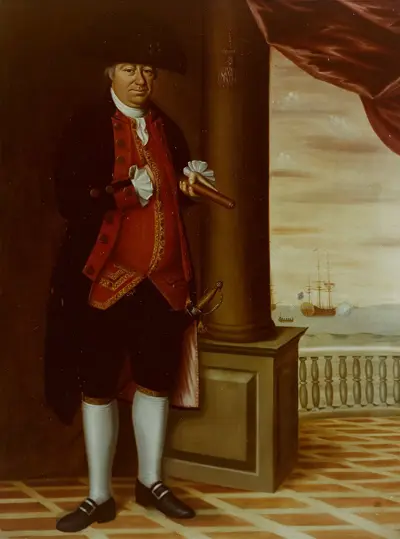
Abraham Whipple was an American Revolutionary War commander in the Continental Navy, and later one of the founders of Marietta, Ohio. Born near Providence, Colony of Rhode Island, Whipple chose to be a seafarer early in his life and embarked on a career in the lucrative West Indies trade, working for Moses and John Brown. In the French and Indian War period, he became a privateersman and commanded privateer Game Cock from 1759 to 1760. In one six-month cruise, he captured 23 French ships.
