Charles Lyell Quotes
I may conclude this chapter by quoting a saying of Professor Agassiz, that whenever a new and startling fact is brought to light in science, people first say, 'it is not true,' then that 'it is contrary to religion,' and lastly, 'that everybody knew it before.'
Lyell, Charles. The Geological Evidences of the Antiquity of Man. John Murray, 1863.


Citizen of U. S. & Israel

Science has the interesting characteristic that most failures are successes in the sense that scientific knowledge is gained from the failure even if it only a guide to what not to do in the future. Politics would be well served to adopt this pragmatic approach, but ideology usually prevails in politics and errors tend to be repeated if there are supported by political philosophy or ideology.

This characteristic of science causes the politicians great difficulty when allocating public funds for scientific research. It is often very hard to attribute credit to the right scientist when a scientist herself might not yet realize the great significance of her work. Of a number of different scientists each contributing one step of a process when the person who worked on the last link could not possibly have done it without the others along the way. Who to fund and why is terribly frustrating which is why the National Science Foundation and the National Institutes of Health make most of their funding decisions on the basis of proposals and peer review and decision making. None the less, many politicians are constantly trying to interject their preferences, almost always based on their ignorance, especially when they can get research funds into their district.
In politics, a person who flip flops is suspected of not having principles. In science, a person who does not flop flop is suspected of not being scientific. As new evidence amasses, the scientific method requires that the scientist chenges. The politician is often expected to hold to his principles regardless of new or contrary evidence.


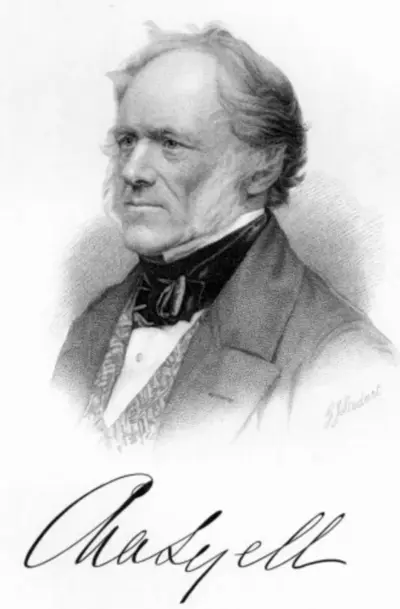
Sir Charles Lyell, 1st Baronet, FRS was a Scottish geologist who demonstrated the power of known natural causes in explaining Earth's history. He is best known as the author of Principles of Geology (1830–33), which presented to a wide public audience the idea that Earth was shaped by the same natural processes still in operation today, operating at similar intensities. The philosopher William Whewell termed this gradualistic view "uniformitarianism" and contrasted it with catastrophism, which had been championed by Georges Cuvier and was better accepted in Europe. The combination of evidence and eloquence in Principles convinced a wide range of readers of the significance of "deep time" for understanding the Earth and environment.
