Genghis Khan Quotes
I know you are a rich and great king. You have plenty of soldiers and govern a big country yourself. Therefore it is difficult for you to subject yourself to me voluntarily. Still, it would be better if you swore fealty to me … You who live in houses, who have castles and towns, how will you escape me?
This is one of the best examples of the Mongol Terror Tactics. They had a completely mobile fighting force. They could evade any large army and attack fixed towns and villages, while opponents could not defend all the locations without enormous expense. The calculus was often that it was cheaper to pay the Mongols tribute than it was to even beat them in the field. In this case, the Hungarians settled and a Mongol satellite group—the Cumans (Western Kipchaks)—moved into Hungary and have been a minority there ever since.
Genghis Khan, c. 1152-1227, Temujin, Mongol Conqueror, Letter to Hungarian King Bela IV
Sourced by: Eigen's Political and Historical Quotations

Secretary of the Navy
Juan Lopez de Vivero. This document was a written declaration of sovereignty and war, read by Spanish military forces to assert their sovereignty (a dominating control ) over the Americas and their peoples. He issued it on “behalf of the King, Don Fernando, and of Doña Juana I, his daughter, Queen of Castille. and León”. It was read to the native peoples of the New World in Spanish which they did not understand and then were held to it on penalty of death thereafter. It was the legal and philosophical foundation for the worst example of colonial abuse in history.


Paine was describing the conquest of England in 1066 by William the Conqueror.

Conceptually this is one of the most absurd documents in history, written by a European King to the native Indians of the new world, virtually all of whom were illiterate, knew nothing of Christianity or of European politics.

Honore Gabriel Victor Requiti
This was not the ravings of a right wing extremist. It was normative for Prussia as a whole. Right wing extremism as we think of it today was the norm of the ruling classes in Prussia and other parts of Germany. This book was a best seller in Germany. This quotation illustrates the mentality of the conservative, militarist, culture that dominated Germany at the time. The German aggression of WWI was not even considered as immoral but a God-given right.


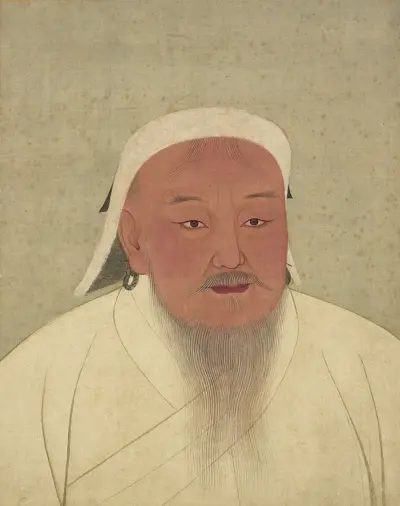
Genghis Khan, was the founder and first Great Khan (Emperor) of the Mongol Empire, which became the largest contiguous empire in history after his death. He came to power by uniting many of the nomadic tribes of Northeast Asia. After founding the Empire and being proclaimed Genghis Khan (an honorary title possibly derived from the Turkic "tengiz" — sea, meaning "the oceanic, universal ruler"), he launched the Mongol invasions that conquered most of Eurasia, reaching as far west as Poland in Europe and the Levant in the Middle East. Campaigns initiated in his lifetime include those against the Qara Khitai, Khwarezmia, and the Western Xia and Jin dynasties, and raids into Medieval Georgia, the Kievan Rus', and Volga Bulgaria. These campaigns were often accompanied by large-scale massacres of the civilian populations, especially in the Khwarazmian and Western Xia-controlled lands. Because of this brutality, which left millions dead, he is considered by many to have been a brutal ruler. By the end of his life, the Mongol Empire occupied a substantial portion of Central Asia and China. Due to his exceptional military successes, Genghis Khan is often considered to be one of the greatest conquerors of all time.
