John C. Calhoun Quotes
I know that there is a great diversity of opinion as to who, in fact, pays the duties on imports. I do not intend to discuss that point. We of the staple and exporting States have long settled the question for ourselves, almost unanimously, from sad experience.
Calhoun, John C. The Works of John C. Calhoun. Edited by Richard K. Crallé, vol. 4, D. Appleton and Company, 1854.


Most Republicans at the time were beholden to corporations and business who then demanded high tariffs and other protectionisms so they could maintain high prices and not have to compete with British and European imports. Roosevelt and a few other reform Republicans were free traders along with most Democrats. Roosevelt had so many other reforms in the fire that he decided not to take this one on at the same time and thought that the benefit would not be good enough for the nation to offset the open civil war of the Republican Party that would ensue. In the latter half of the 20th century, large American companies had opened or invested in foreign corporations and/or were manufacturing many of their products abroad. So they then advocated free trade. When they did, the Republican Party flip flopped and adopted free trade as one of its basic principles. Meanwhile, the Democrats who were free traders in the early 20th Century had become protectionists by the end of the 20th century as labor movement wanted to protect American jobs.


Although aggregate employment has remained relatively stable as global free trade has become the U. S. policy, there has been major employment disruption with some types of people benefiting and others like blue collar manufacturing workers having their entire careers wiped out. Port cities like Seattle, Baltimore have boomed while Midwestern manufacturing cities have deteriorated greatly.

South Carolina did not like the protectionist measures that Congress had passed. Although the Federal Government clearly had the Constitutional authority to regulate interstate and international commerce, South Carolina, led by John C. Calhoun, took the position that any state could nullify a Federal law’s application within their state. Clearly, that was a vision of a nation that would have very different from our history where the Federal Courts were the only institution that could nullify an act of Congress anywhere.

Republicans at that time were adamant protectionists and were violently opposed to free trade. They made a total flip flop on free trade after the Second Word War when the industrial capacity of all of the major industrial nations except America was completely emaciated. America still had production and there was huge money to be made from being the only nation that could deliver goods to the world. Meanwhile Germany, France, England, and Italy, our largest competitors could hardly manufacture for their own needs and could not compete in the American market. So the American corporations then wanted to become free traders.

See {634234} and {634238} for more of his arguments at the Ratification Convention.

The American colonists were not allowed to sell their tobacco or other products to foreign nations. They could only sell them to English merchants who in turn would sell them to foreign markets. Thus, the large profits on American tobacco were made by English merchants and not by American farmers or merchants.

In this case the tariffs were imposed not to protect national industries but to simply raise revenue. In the early years of the United States, almost all of the Federal Revenue was raised this way.


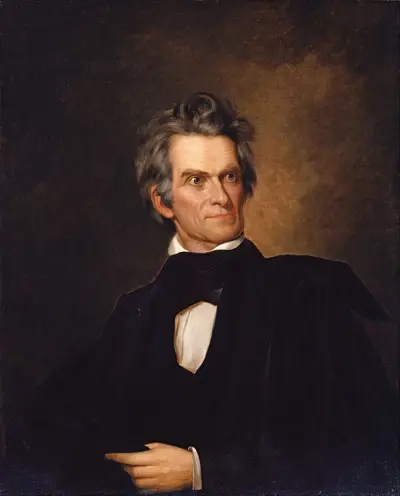
John Caldwell Calhoun was an American politician and political theorist from South Carolina who held many important positions including being the seventh vice president of the United States from 1825 to 1832, while adamantly defending slavery and protecting the interests of the white South when its residents were outnumbered by Northerners. He began his political career as a nationalist, modernizer, and proponent of a strong national government and protective tariffs. In the late 1820s, his views changed radically, and he became a leading proponent of states' rights, limited government, nullification, and opposition to high tariffs. He saw Northern acceptance of those policies as a condition of the South remaining in the Union. His beliefs and warnings heavily influenced the South's secession from the Union in 1860–1861.
