Alan Greenspan Quotes
I have long argued that paying down the national debt is beneficial for the economy: it keeps interest rates lower than they otherwise would be and frees savings to finance increases in the capital stock, thereby boosting productivity and real incomes.
Greenspan, Alan. Testimony before the Committee on the Budget, U.S. Senate, January 25, 2001.


Almost every major corporation that is growing must borrow money to finance the growth. There is a great temptation to do this continuously, as if all works out the borrowed money is paid back and the nation has grown. However, not every investment succeeds, and when they do, few nations will take the growth and save it for a future date when a national investment does not work out as well as hoped. Gradually national debt as a proportion of the economy gets larger and larger and it makes mew investments more and more difficult to succeed because of the higher rates of interest that must be paid. Every modern country must find a balance. Those that do not can have a financial disaster such as Greece in the early part of the 21st century.


Ironically, Fitzhugh who detested socialism, held this basic socialist principle. His solution however, was that the profits were necessary for society, and therefore slavery was the solution for Blacks AND whites.


At the time there was a worldwide recession and although the United States economy was not in very good shape, it was better than the other democracies and those nations with better economies then were authoritarian governments where investors did not trust their currencies. As a result, many wealthy people and businesses throughout the world were willing to lend money to the United States as a safe haven.


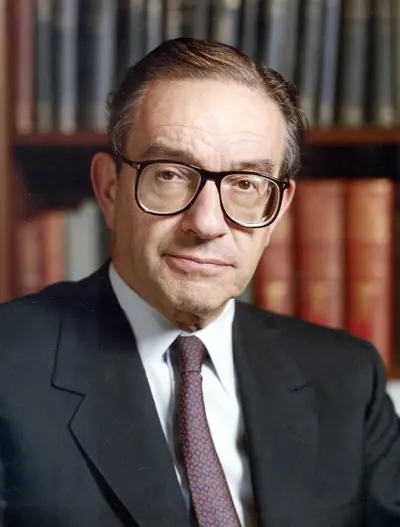
Alan Greenspan is an American economist who served five terms as the 13th Chair of the Federal Reserve of the United States from 1987 to 2006. He works as a private adviser and provides consulting for firms through his company, Greenspan Associates LLC. First appointed Federal Reserve chairman by President Ronald Reagan in August 1987, he was reappointed at successive four-year intervals until retiring on January 31, 2006, after the second-longest tenure in the position (behind William McChesney Martin).
