Pierre de Fermat Quotes
I have found a very great number of exceedingly beautiful theorems.
Fermat, Pierre de. "Letter to Pierre de Carcavi, August 1659." The Mathematical Career of Pierre de Fermat, 1601-1665, by Michael Sean Mahoney, Princeton University Press, 1994, p. 348.


3rd Earl Russell of Kingston. In mathematics the numbers can count people, autos, sins, molecules, or paintings. The mathematician does not know or care. And the mathematics is the same regardless. And the fundamentals themselves are unknown. For example, what is a number? It’s not the symbol we write; that is a numeral. Some say that it is an abstract idea that represents a quantity like 5. But what is 5? That itself is an abstraction. So few mathematicians and no layman know what they are talking about when they do mathematics. Lord Russell, with his colleague Whitehead, built up a system where they could define a number as a set with certain properties. But they take 3 large volumes full of equations in a small type font to just get to 3rd grade arithmetic and knowing what they are talking about. In politics, we also often do not know what we are talking about, but that is for a much simpler set of reasons.
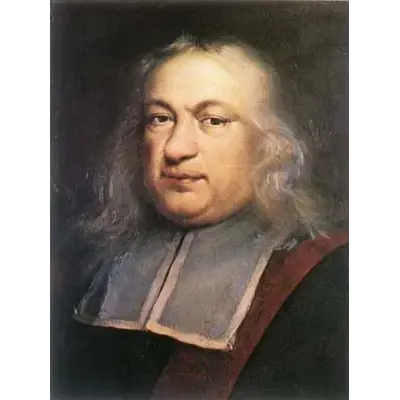
Pierre de Fermat was a French lawyer at the Parlement of Toulouse, France, and a mathematician who is given credit for early developments that led to infinitesimal calculus, including his technique of adequality. In particular, he is recognized for his discovery of an original method of finding the greatest and the smallest ordinates of curved lines, which is analogous to that of differential calculus, then unknown, and his research into number theory. He made notable contributions to analytic geometry, probability, and optics. He is best known for his Fermat's principle for light propagation and his Fermat's Last Theorem in number theory, which he described in a note at the margin of a copy of Diophantus' Arithmetica.
