Jan Hus Quotes
I entreat masters to live a good life and faithfully to instruct their scholars, especially that they may love God and learn to give themselves to knowledge, in order to promote His honour, the welfare of the state, and their own salvation, but not for the sake of avarice or the praise of man.
Hus, Jan. The Letters of John Hus. Translated by Herbert B. Workman and R. Martin Pope, Hodder and Stoughton, 1904, p. 232.


Only six years later, the University was intellectually and politically split asunder when the prestigious chairman of the Geology Department wrote that the fossil record was at variance with the date the church had ascribed to Adam and Eve. Vanderbuilt was then controlled by the Tennessee Methodist Episcopal whose Bishop served as its President. See {612709} and {612831}.


At that time, and in much of the world today, religious preaching and those who do it are licensed by the state. Lucian’s response was one of the first statements that governments and temporal powers endorsement was not required, nor was any formal ordination or grant of authority from a formal church as existed among the pagans of the time where the religion was seen as another extension of the state. Even in America there is some ambivalence on this point. Many religions require not only training but a grant of authority from the religious hierarchy. Others such as some Baptists and many Protestant Fundamentalist groups believe that no specific authority is needed other than the “calling of god.” Lucian was apparently the first person to claim the authority as an individual. He was burnt alive for his position. There is a second Saint Lucian. To distinguish the latter is often referred to as Saint Lucian the Syrian.
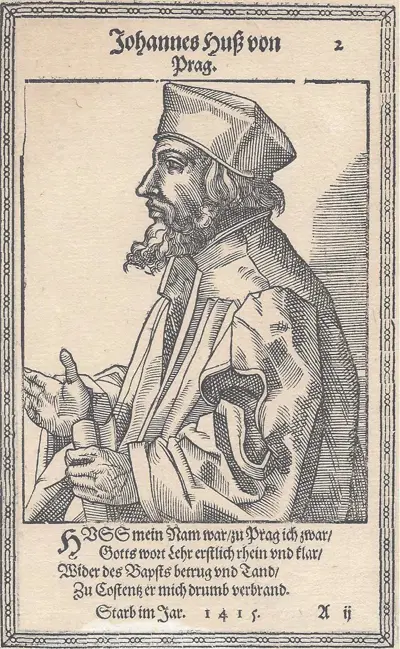
Jan Hus, sometimes anglicized as John Hus or John Huss, and referred to in historical texts as Iohannes Hus or Johannes Huss, was a Czech theologian and philosopher who became a Church reformer and the inspiration of Hussitism, a key predecessor to Protestantism and a seminal figure in the Bohemian Reformation. After John Wycliffe, the theorist of ecclesiastical reform, Hus is considered the second Church reformer, as he lived before Luther, Calvin and Zwingli. His teachings had a strong influence on the states of Western Europe, most immediately in the approval of a reformed Bohemian religious denomination and, over a century later, on Martin Luther. Hus was a master, dean, and rector at the Charles University in Prague.
