Christopher Hitchens Quotes
I don't regard myself as any kind of conservative, except conceivably neo, and that word, of course, is a ridiculous appellation, because it's used to describe a group that was ready to make war on the status quo, which is not a conservative position.
Hitchens, Christopher. Arguably: Essays by Christopher Hitchens. Twelve, 2011.


This is not only attributed by reliable sources but apparently Roosevelt had said this on several occasions. The word “radical” has had different shades of meaning at different periods of American History. The origin of the word from the Latin means someone who wishes to change things very rapidly and not gradually. In the time of the Civil War, the majority of the Republicans proudly referred to themselves as “radicals” or “radical Republicans” because they wanted to abolish slavery immediately. In the late 19th century the word “radical” referred to anarchists. From the Russian Revolution onward “radicals” were communists who presumably wanted to change governments throughout the work through revolution—very rapid change. However, in the early 20th century, radicals were people who wanted to reform and regulate businesses and monopolies rapidly and it is this sense he was a radical. But by style, he was a radical in most things in that he wanted to change things and change them rapidly.


Although very authoritarian in his governing style, the substance of the Constitution that and basic laws that he imposed on post war Japan were extremely left wing. Japan eschewed having a military, required total equality of women for the first time in Japanese history. The Civil Service was given great power and authority over business, there was a complete social safety net. MacArthur would not take kindly to this characterization as he thought of himself as a lifelong conservative and was the darling of the American right wing extremists. He took the American Constitution literally and was determined to turn ultra-militaristic Japan into a democracy. He did in one of the most dramatic cultural and governmental changes in history.


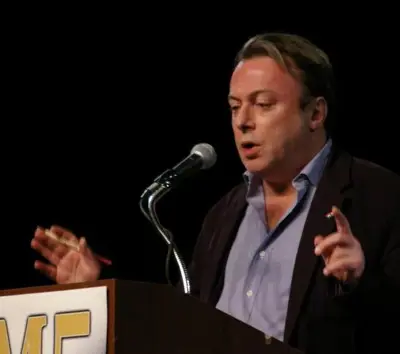
Christopher Eric Hitchens was an English-American intellectual, polemicist, and socio-political critic, who expressed himself as an author, orator, essayist and columnist. He wrote, co-wrote, edited or co-edited over 30 books, including five of essays on culture, politics and literature. Having contributed to several publications, he is broadly regarded as one of the most influential atheists of all time.
