Michael Servetus Quotes
I do not separate Christ from God more than a voice from the speaker or a beam from the sun. Christ is the voice of the speaker. He and the Father are the same thing, as the beam and the light, are the same light.
Servetus, Michael. The Two Treatises of Servetus on the Trinity. Translated by Earl Morse Wilbur, Harvard University Press, 1932.


At the time, it was very difficult for people who had been taught all their lives that God was directly responsible for the creation to accept the notion of evolution. At the time, there was not the overwhelming evidence proving Darwin’s theory that we have today. Nor did theologians realize that evolution and Darwinism were not inconsistent with the concept of a creator and supreme being. Nonetheless, there are still those who, like Agassiz, reject evolution and insist that the Biblical version of creation is literally true. See {586990}. Then there are people who have come up with the concept of Intelligent Design which originated with Agassiz though he never called it that. Most religious people today, in contrast, see no conflict in natural selection as described by Darwin and later proven, and the concept of God. They see the Biblical creation as metaphorical and natural selection as the product of an omniscient supreme being.


Even in free America, Allen had a very difficult time getting this work printed because it was so controversial culturally and religiously. However, there was a large population of Unitarians in America at the time and Allen’s view was not that unusual. Some of the founding fathers like Adams and Jeffersion were deists who not only did not believe in the trinity but questioned the divinity of Christ.


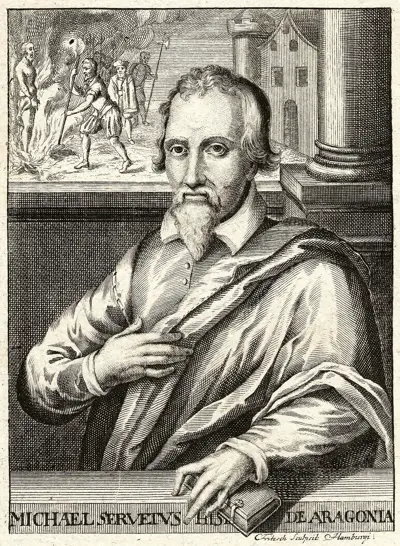
Michael Servetus was a Spanish theologian, physician, cartographer, and Renaissance humanist. He was the first European to correctly describe the function of pulmonary circulation, as discussed in Christianismi Restitutio (1553). He was a polymath versed in many sciences: mathematics, astronomy and meteorology, geography, human anatomy, medicine and pharmacology, as well as jurisprudence, translation, poetry and the scholarly study of the Bible in its original languages.
