Paul Robeson Quotes
I do not hesitate one second to state clearly and unmistakably: I belong to the American resistance movement which fights against American imperialism, just as the resistance movement fought against Hitler.
Robeson, Paul. "Speech at the World Peace Congress, Paris, April 20, 1949." Paul Robeson Speaks: Writings, Speeches, Interviews 1918-1974, edited by Philip S. Foner, Brunner/Mazel, 1978, p. 195.

Massachusetts rioters who had distressed Abigail Adams and others were pardoned for their crimes. Jefferson was responding to her concerns {592539} and providing her with the pardon news.


This is one of the first literary works explicitly attacking Fascism at the start of WWII. The quotation is a line of the protagonist. The play opened in New York and shortly after President Roosevelt ordered a command performance at the National Theater in Washington. A Movie with Bette Davis and Paul Lukas was then made of the play. Many films and plays with anti-Fascist, anti-Nazi themes followed.


Guthrie, if in any other field, would have been called a “reformer”. He always felt that singing about freedom, rights, patriotism, fairness and other American traditional virtues strengthened American values and resistance to Fascists, who had their own songs. For example, see {42323}.


The Nazis who numbered as many as 20,000 at the peak would hold rallies describing them as American patriotic rallies. Many people would unwittingly swell the halls. Madison Square Garden was then the largest indoor facility in New York. The press revealed the Nazi deception and uncovered many of the other Nazi activities in America, which brought Nazi attacks on the press—see {625042}.


The two were in the Dublin suburbs when others seized the Dublin Post Office and began the Easter Uprising without their knowledge. They were desperate to get to Downtown Dublin and have a role in the activities and get arrested with the more militant leaders.


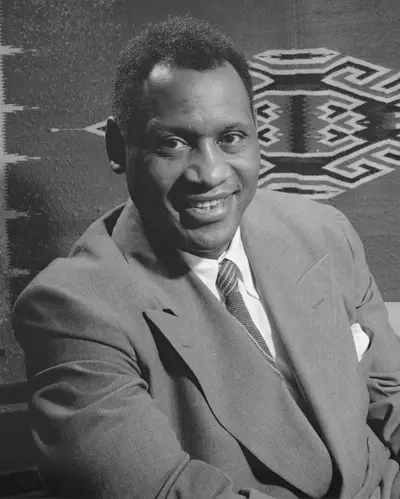
Paul Leroy Robeson was an American bass baritone concert artist and stage and film actor who became famous both for his cultural accomplishments and for his political activism. Educated at Rutgers College and Columbia University, he was a star athlete in his youth. He also studied Swahili and phonetics at the School of Oriental and African Studies in London in 1934. His political activities began with his involvement with unemployed workers and anti-imperialist students whom he met in Britain and continued with support for the Republican cause in the Spanish Civil War and his opposition to fascism. In the United States he became active in the Civil Rights Movement and other social justice campaigns. His sympathies for the Soviet Union and for communism, and his criticism of the United States government and its foreign policies, caused him to be blacklisted during the McCarthy era.
