J. Edgar Hoover Quotes
I consider [Martin Luther] King to be the most notorious liar in the country—one of the lowest characters in the country and controlled by the communists.
J. Edgar Hoover, 1895-1972, Director, Federal Bureau of Investigation, News Conference, Washington DC, November 18, 1964
Sourced by: Eigen's Political and Historical Quotations

Hoover and the FBI were supposed to be enforcing Federal law. However, they could not find any criminal activity on the part of Martin Luther King Jr. They regarded the Civil Rights Movement as a revolutionary threat to the nation. See {620621} and {74219} . So the FBI in an incredible abuse of power, had a meeting of its top officials to plan a strategy for destroying King as a Negro leader in America. We look back on this era where officials who were never elected by anyone, and having no authority from an elected official, took it upon themselves to decide who leaders in America would be.


Referring to Martin Luther King: Hoover tried to prejudice his staff against King when King had not committed any crimes other than being arrested for demonstrating in the South. Hoover ordered a wire tap on King and while no crime was discovered, they learned that King was engaged in some extra marital sexual liaisons. Hoover at the time was in a clandestine, secret, monogamous relationship with another male official of the FBI. Yet he was offended by King's promiscuity. Hoover honestly believed that segregation was the American way, and King's civil rights and equality advocacy in his view was an important part of the Communist program.


In Helms bizarre view, the University of North Carolina which had desegregated and had Black students and faculty was communist. In the beginning of the Cold War, the Communists of the world frequently attacked the United States for its Racial Segregation and Discrimination before the Civil Rights Bill was passed. It was one of the great shames and weaknesses of America as slavery had been earlier. Southern racists then conflated the civil rights issue and Communism. Since all communists seemed opposed to segregation, then it followed, they erroneously reasoned, that all opponents of segregation were communists. See {622174} for another of Helms vicious smears using this twisted logic.

Hoover was an inveterate racist and had an extreme hatred of King. A month later King was awarded the Nobel Peace Prize. What was not known at the time was Hoover, although it had nothing to do with law enforcement, actually contacted New York Cardinal Spellman and illegally transmitted to him parts of FBI confidential and secret files on King for the purpose of persuading the Pope not to grant King an audience. Nonetheless, Hoover himself had a behind the scenes reputation of leaking for his personal purposes and that much of the contents of many FBI files were notes on unsubstantiated claims made by political enemies and often far from the truth. The Cardinal, the Pope and their staffs chose to ignore the Hoover materials.

Schuyler was an ardent atheist and a major opponent of organized religion which he regarded as one or the major initiators and drivers of slavery, segregation and discrimination—see related quote. This is why he was critical of Martin Luther King. His irreligiosity prevented his gaining much support from his fellow African Americans even though a great writer like H. L. Menken considered Schuyler, "the best writer in America.”


The logic of the Southern leaders and some Northern racists like FBI Director J. Edgar Hoover was to fight the Civil Rights Movement using the Red Scare. The Communist Party called for an end to legal segregation and discrimination against Negroes. Therefore, those who advocated an end to segregation were either Communists or dupes of the Communists was their “logic”.


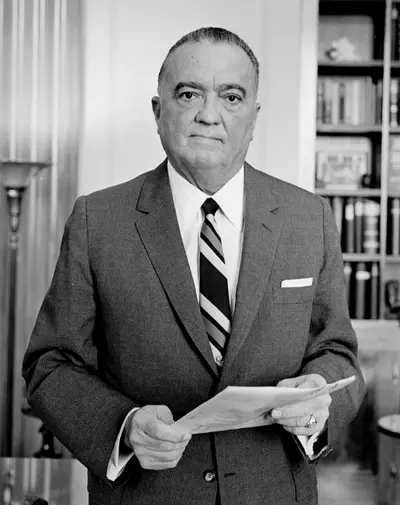
John Edgar Hoover was an American law enforcement administrator who served as the first Director of the Federal Bureau of Investigation (FBI) of the United States. He was appointed director of the Bureau of Investigation – the FBI's predecessor – in 1924 and was instrumental in founding the FBI in 1935, where he remained director for another 37 years until his death in 1972 at the age of 77. Hoover has been credited with building the FBI into a larger crime-fighting agency than it was at its inception and with instituting a number of modernizations to police technology, such as a centralized fingerprint file and forensic laboratories. Hoover is also credited with establishing and expanding a national blacklist, referred to as the FBI Index or Index List, renamed in 2001 as the Terrorist Screening Database which the FBI still compiles and manages.
