Adolf Hitler Quotes
I conceived the most profound admiration for ...[Mussolini, who] ... would not deal with the internal enemies of Italy, but pushed their annihilation in every way and by all means.
Adolf Hitler, 1889-1945, Fuhrer of the Third German Reich, Mein Kampf, 1925
Sourced by: Eigen's Political and Historical Quotations


Egypt, after is Arab Spring ousting of it like time military dictator, suffered through and Islamic government regeime, but after that ended up electing a military strongman again who had little inclination towards democracy and was decidedly fascistic. In November 2013, the Robert F. Kennedy Center for Justice and Human Rights presented Omran with an award to honor her work and commitment to human rights in Egypt.


Both of these famous Americans were admirers of Nazi Germany and Adolf Hitler. They both accepted medals from the German dictator. And both of them were apologists for German aggression and urged the United States not to side with England and to stay neutral in the War. The next year Germany declared war on the United States.


Incredibly enough, Gils Robles was only right of center with outright Fascist Nazi groups active in Spanish politics. One of the propaganda myths of the Spanish right at the time was that the poor economy and the Basque and Catalan separatist movements were the result of the activity of the Masons and Jewish influences. Also,Confederacion Espanola, de Derechas Automomas his call for a totalitarian government was typical of the right wing of the time whop distrusted democracy completely.


This quotation brought Mises much criticism at the time and has destroyed his moral credibility for the rest of his career. Like many others who supported the wealthy ruling classes, he expressed admiration for Fascism. Worse he claimed that Nazi German and Italian Fascism saved Europe when subsequent events proved that they destroyed Europe along with 30-40 million people killed. However, unlike most of the right wing Fascist enthusiasts of the day, he did—in the last sentence of this quotation which is often omitted by critical quoters—observe that Fascism success would not be permanent or long lived. His lack of moral condemnation of Fascism and Fascists however was clear. Some of his apologists and decuples observe that his philosophy tended to avoid all kinds of moral judgments pro and con about almost everything. It was this lack of a moral / ethical framework that most of his critics point to as a great failing of his. Also, many argue that this is another example of Mises tendency to exaggerate. Mises also took great criticism on what he claimed were “best intentions”; this included virulent racial and religious discrimination, militarism, aggression and expansionism, persecution of the handicapped. Ironically much later, Mises admitted that all of the Nazi evil was clear before it was implemented, {632449}. Some scholars think that Mises who was almost amoral outside the context of economics, began to develop a moral awareness in the reality of the Nazi charnel that much of Europe had become. One problem is that a person like Mises loses much credibility because of his lack of moral sensibilities and moral perception of a way of life and then exaggerates so many of his examples. However, many of his ideas and insights are very important in man’s quest of an economic system that produces substantial increases in standard of living and development and at the same time assure a modicum of subsistence and dignity and a fair opportunity to achieve much more. Mises’s ideas should not be ignored because of the failings of Mises the man.
_0_thumbnail_47x47.jpg)
He was countering the argument of unlimited free speech advocates that fascist hate speech should not be countered by more speech on teh other side. Historically, he observed, that Fascism has only been defeated by force and control.


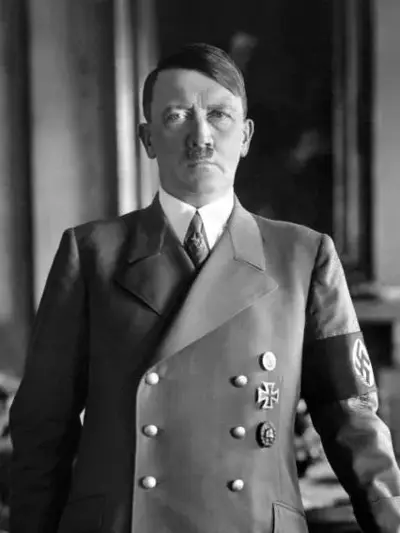
Adolf Hitler was an Austrian-born German politician who was the dictator of Germany from 1933 to 1945. He rose to power as the leader of the Nazi Party, becoming Chancellor in 1933 and then assuming the title of Führer und Reichskanzler in 1934. During his dictatorship from 1933 to 1945, he initiated World War II in Europe by invading Poland on 1 September 1939. He was closely involved in military operations throughout the war and was central to the perpetration of the Holocaust, the genocide of about 6 million Jews and millions of other victims.
