John C. Calhoun Quotes
I cannot think in the present state of parties of entering again on the political arena. I would but waste my strength and exhaust my time, without adding to my character, or rendering service to the country, or advancing the cause for which I have so long contended…. I am content, and willing to end my publick life now. In looking back, I see nothing to regret, and little to correct. My interest in the prosperity of the country, and the success of our peculiar and sublime political system when well understood, remain without abatement, and will do so till my last breath; and I shall ever stand prepared to serve the country, whenever I shall see reasonable prospect of doing so.
He was fed up with Party politics.
John C. Calhoun, 1782-1850, Vice President of the United States (Democrat, SC), U. S. Congressman & Senator (Democrat, SC), U. S. Congressman & Senator, Letter to Duff Green, February 10, 1844
Sourced by: Eigen's Political and Historical Quotations


When Roosevelt was elected Governor of NY State, the State Party Boss Platt saw patronage and contracts was the most important services the Governor should render to the Party. TR had a different view as expressed here.


Political disputes over the degree of defense spending are classic in American political history. In the early 20th century, most conservatives were opposed to government spending for the military and the President had great difficulty getting the Conservative wing of his own party to support increased military appropriations. The remains of the great naval hero John Paul Jones had just been brought to the United States from France in which he had died. A large ceremony was held in Annapolis, Maryland and most of the conservatives who had opposed the military spending proposed by Roosevelt attended the ceremony to demonstrate their patriotism. TR shocked them by turning the solemn ceremony into a political embarrassment for them.
Many people have erroneously credited the water’s edge analogy to senator Arthur Vandenberg who made the same point very effectively in 1950. See {36673}.


Buchanan, the Bachelor President, was wedded to public service. His self-deprecating remark quickly became his own nickname—O.p. f.


The Society of Cincinnati was formed just after the Revolutionary War by officers of the army, to perpetuate friendships, to aid each other and the widows and orphans of members, and to honor their French allies and comrades:


Discussing alleged meager compensation for public service:

In the spring of 1800 New York State legislators were elected. The legislators were then to choose the presidential electors. If New York's electors voted for Jefferson he would likely beat the Federalists, who had just lost their majority in the legislature. Alexander Hamilton wrote to fellow Federalist Governor John Jay proposing to have the sitting legislature change the law to select Presidential electors by popular vote:


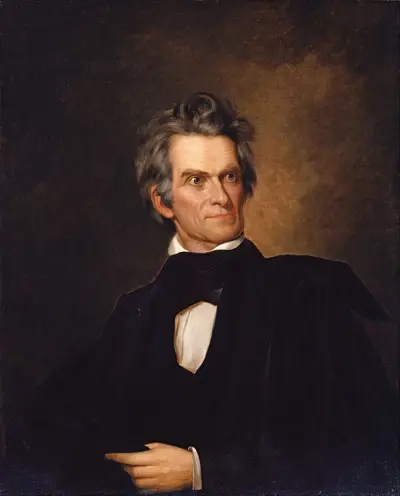
John Caldwell Calhoun was an American politician and political theorist from South Carolina who held many important positions including being the seventh vice president of the United States from 1825 to 1832, while adamantly defending slavery and protecting the interests of the white South when its residents were outnumbered by Northerners. He began his political career as a nationalist, modernizer, and proponent of a strong national government and protective tariffs. In the late 1820s, his views changed radically, and he became a leading proponent of states' rights, limited government, nullification, and opposition to high tariffs. He saw Northern acceptance of those policies as a condition of the South remaining in the Union. His beliefs and warnings heavily influenced the South's secession from the Union in 1860–1861.
