Geronimo Quotes
I am thankful that the President of the United States has given me permission to tell my story. I hope that he and those in authority under him will read my story and judge whether my people have been rightly treated
Geronimo, 1829-1909, Apache Chief, Autobiography
Sourced by: Eigen's Political and Historical Quotations

In the Watergate crisis H. R. Haldeman had asked for a Presidential pardon. A discussion of the request was held by some White House staff members:


After Adams’ term as President, he was elected to the House of Representatives where he served for the rest of his career. He was constantly calling for the emancipation of slaves (see {77463}) in the House debates. The Southern Congressmen were so offended by this that they got the majority of the House to pass a rule that made using the word “slavery” out of order. It was called the “Gag Rule”. Adams, one of the best legislators and lawyers of his day, then started reading in the House debates petitions of his constituents calling for an end to slavery. The Southerners called for the Speaker to declare him out of order for violating the gag rule. But Adams pointed out that the Constitution gave citizens the right to petition Congress with no controls on the petitions. Therefore the reading of the petitions was Constitutionally mandated and trumped the Rules of the House. He then arranged to have many petitions submitted which he dutifully read on the House floor to the extreme anger of the Southerners.


Bush’s critics point to this quotation to illustrate how Bush’s concept of human rights differs from most. Albeit under the pressure of coping with the War on Terror after 9-11, some of Bush’s policies and practices went to new extremes in violation of human and civil rights for both Americans and others. Privacy intrusions and incarceration without charges or a chance to have an attorney were among those. In addition there were terrible violations which were the result of Bush human rights policies and statements such as Abu Gharib where officers and men were under the impression that the gross human rights practices were approved and consistent with the interrogation practices of the administration.

This is an amazing speech which illustrated the best of the development and growth of Islam. Note that: The ruler who has just been given ALL secular AND religious power admits candidly that he may not be the best qualified. This would not happen for over another 1000 years and even today is very rare in any society. In addition, he invites the citizens to correct him when he is wrong. Later, Calihs would, like the Christian kings and popes claim infallibiity and kill any who suggested otherwise. And daring to correct the ruler was capital offence for most of history and is even dangerous in some Muslim countries today. Last and perhaps most amazing, the new Caliph called for an affirmative leveling of the inequality of rights and power and announces it asa one of his major responsiblities. It is this kind of vision so unheard of at the time which shows us why so many flocked to Islam at the time. From a fairness, human rights, and accoutabiity of the ruler point of view Islam was the most modern of the religions then. Tragically, other forces shaped Islam for the next 1500 years and most Muslim countries become the least modern and its rulers are least accountable to the citizenry with none of the other rights and concept of fairness that Abu Bakr and other early Islamic leaders brought.


Early in the Donald Trump Presidency, some of his first decisions, including his Anti-Muslim ban on immigration and vistitation from 7 Islamic nations, were very distrubing to amy politicians experienced in national security and defense. 100 leaders from past adminsitrations, Democratic and Republicans, signed a petition warning that the travek ban endangered our national security. Then 1000 U. S. State Department Diplomats signed a letter advising the President to recind the order for similar reasons. Malinowski was asked if this kind of opposition to a new presidents actions was unusual. This quotation was his reply. Not the use of sarcasim. He states what happened in very stark terms and then says that it is not unusual and there is notjing to worry about, when it was withotu precedent ever and very worrisome to him and others. Quotations using sarcasim are very problimatical becasue just a literal reading, would lead us to believe he was not concened with sich a common occurance.

She was at the time the European Commissioner for Competition


What is interesting about this quotation is how early in America’s history the insignificance of the Vice Presidency was discussed.


This was the group that decided who was to be executed in the Reign of Terror
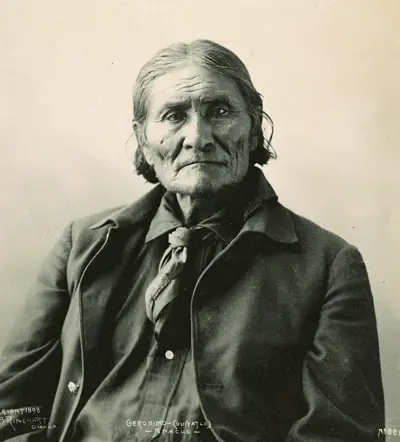
Geronimo was a prominent leader and medicine man from the Bedonkohe band of the Apache tribe. From 1850 to 1886, Geronimo joined with members of three other Chiricahua Apache bands—the Tchihende, the Tsokanende and the Nednhi—to carry out numerous raids, as well as fight against Mexican and U.S. military campaigns in the northern Mexico states of Chihuahua and Sonora and in the southwestern American territories of New Mexico and Arizona. Geronimo's raids and related combat actions were a part of the prolonged period of the Apache–United States conflict, which started with American settlement in Apache lands following the end of the war with Mexico in 1848.
