John Brown Quotes
I am quite certain that the crimes of this guilty land will never be purged away but with blood. I had, as I now think vainly, flattered myself that without very much bloodshed it might be done.
Brown, John. Note handed to Hiram O'Bannon. 2 Dec. 1859. Quoted in The Life and Letters of John Brown, edited by F. B. Sanborn, Roberts Brothers, 1885, p. 620.


Prior to whites settling in America, various Indian tribes had a long history of fierce fighting for control of Kentucky. The Transylvania Land company negotiated for the “rights” to Kentucky. Dragging Canoe, who opposed the treaty, argued that the land had a bad history and would be very difficult to settle. Poet Theodore O’Hara described Kentuckians as “Sons of the Dark and Bloody Ground” in his poem, The Bivouac of the Dead.

While Queen Mary was presenting medals to British soldiers during World War I, she said this to a soldier who had exclaimed “No more bloody wars for me”.

See Prince Otto von Bismarck-Schoenhausen {632620} for a similar focus on "iron and blood". This is no coincidence as Lindemann had been the Captain of the Battleship Bismarck.

This proverb only makes sense in the light of understanding the Arab concept of revenge—“blood.” In a rural desert environment where little can be expected of government, the Arabs have developed a law enforcement and peace keeping mechanism which while primitive from modern standards, nevertheless worked to some degree. It is that revenge—“blood” is a moral necessity and obligation of all people, and revenge is not limited by time or to the individuals involved in the first incidence. The immediate family are the first to extract revenge, but the extended family follows and often the entire clan. Sometimes revenge is tribal or even national. Anyone who fails to revenge a member in his group is not only a disgrace, but is a clear and present danger to the group because then they can be attacked with impunity. So revenge is a strong obligation of the group members and blood must be paid with blood no matter how many generations it may take. The only thing that keeps me and my family safe, is the surety what whosoever kills one of us will themselves be killed or if they die a natural death we will take revenge on one of the evildoers relatives. Crime must never pay!
This proverb only makes sense in the light of understanding the Arab concept of revenge—“blood.” In a rural desert environment where little can be expected of government, the Arabs have developed a law enforcement and peace keeping mechanism which while primitive from modern standards, nevertheless worked to some degree. It is that revenge—“blood” is a moral necessity and obligation of all people, and revenge is not limited by time or to the individuals involved in the first incidence. The immediate family are the first to exact revenge, but the extended family follows and often the entire clan. Sometimes revenge is tribal or even national. Anyone who fails to revenge a member in his group is not only a disgrace, but is a clear and present danger to the group because then they can be attacked with impunity. So revenge is a strong obligation of the group members and blood must be paid with blood no matter how many generations it may take. The only thing that keeps me and my family safe, is the surety what whosoever kills one of us will themselves be killed or if they die a natural death we will take revenge on one of the evildoers relatives. Crime must never pay! Needless to say, this often produces cycles of violence that might never end but for the principle of this proverb—that the obligation of revenge is heavier upon the relatives of the first victim than upon this who are seeking revenge for previous acts of vengeance.

Lawrence was a thriving community of abolitionists. Quantrill’s irregular force generally murdered prisoners, scalped them, mutilates their bodies, and wore scalps and body parts as clothing decoration. Quantrill “cleansed” Lawrence by burning virtually every building and killing the male population, See {617769}. It has been a source of great argument as to whether the Confederate command and politicians were fully aware of his actions and endorsed them or didn’t know. Since many of his escapades were printed in the Newspapers of the day, it is probably the case that the Confederate authorities had so much to do, that they just didn’t want to determine the truth of the accusations.


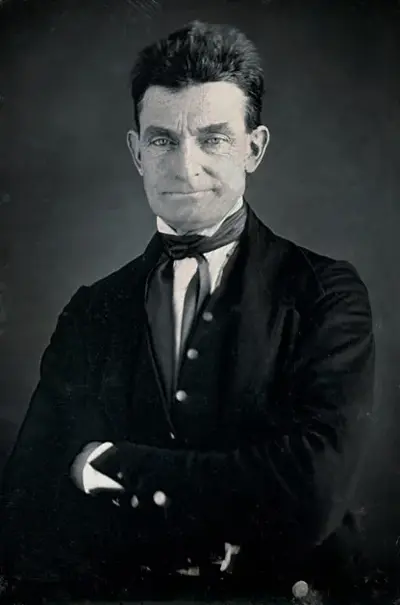
John H. Brown was an American abolitionist leader. Brown felt that violence was necessary to end American slavery, as years of speeches, sermons, petitions, and moral persuasion had failed.
