Eduard Shevardnadze Quotes
I am not responsible for the actions of Saakashvili and even for those of Gamsakhurdia.
Shevardnadze, Eduard. Interview. BBC Monitoring Former Soviet Union, BBC, 25 Nov. 2003.


Parliament had developed a formal mechanism of removing officials in extreme circumstances. It was borrowed for the U. S. Constitution. See {584256}.


Senator Grimes thought that Andrew Johnson was a terrible President, but when the House of Representatives impeached President Johnson and he was tried before the Senate, Grimes voted for acquittal. His reason for the his vote was he thought that the Constitution did not provide for the removal if a President just because he has “Unacceptable.” Johnson survived removal from office by a single vote and had Grimes not been so principled about the Constitution, Johnson would have been removed from office. On the other hand, Johnson was a terrible President and many of the nations racial problems in later years emanated from his actions and inactions while in office.

In the 1952 steel seizure case the justice department took the position that the President's actions were not reviewable by the courts. The judge ruled against Baldridge and the government.

as a result of the Watergate hearings and investigations and proceedings
During the Nixon administration FBI director J. Edgar Hoover was requested by White House operatives to cooperate with "the Houston Plan" of illegal surveillance of many Americans. Hoover refused arguing that it was too risky.


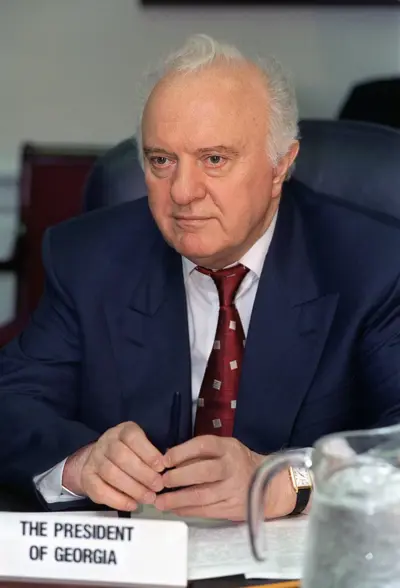
Eduard Ambrosiyevich Shevardnadze was a Georgian politician and diplomat. He served as First Secretary of the Georgian Communist Party (GPC), the de facto leader of Soviet Georgia from 1972 to 1985 and as Minister of Foreign Affairs of the Soviet Union from 1985 to 1991. Shevardnadze was responsible for many key decisions in Soviet foreign policy during the Gorbachev Era including reunification of Germany. Following the dissolution of the Soviet Union, he was President of Georgia (or in equivalent posts) from 1992 to 2003. He was forced to retire in 2003 as a consequence of the bloodless Rose Revolution.
