Jean-Bertrand Aristide Quotes
I am confident that I can serve my country without being involved as the president of the country now.
Aristide, Jean-Bertrand. Interview by Nicolas Rossier. Aristide and the Endless Revolution, Baraka Productions, 2005.


This may be Kennedy’s most famous line. However he was not the first orator to express this idea however. See Khalil Gibran {601423}, Warren G. Harding {622594} and {629021}, St. John Broderick {595734}, and Oliver Wendell Holmes Jr. {603707} for earlier expressions of similar sentiments. Holmes seems to be the first to express the idea while the earliest seems similar phraseology seems to be the British Politician St. John Broderick in 1893 {595734}. Although, these earlier expressions existed, Theodore C. Sorensen, who assisted Kennedy with this speech and wrote the draft, had distilled it from earlier expressions and views of JFK and said that these were Kennedy’s words. At the time, he stated that was unaware of the Gibran, Harding, Broderick and Holmes sentiments. Gibran had not yet even been translated into English. However it is not clear whether Kennedy himself had inadvertently recollected the phrase from any of the other quotations. (The question was never put to him.) The St. John Broderick quotation is a possible source. Kennedy was quite familiar with British political history, and his father and been U. S. Ambassador to Great Britain. Regardless, the quotation was as great for the place and timing—his inaugural—as it was for the phraseology which might have originated elsewhere.

This quotation might have been an inspiration for the famous JFK quotation {589867}. See Khalil Gibran {601423}, Warren G. Harding {622594} and {629021}, and Oliver Wendell Holmes Jr. {603707} for similar sentiments. Holmes preceded Broderick by a few years, but Broderick came closest to the Kennedy phraseology.
Roosevelt was such a breath of fresh air as a politician that cynical political journalists saw him as almost a savior of American politics at the time. His dynamic personality, independence from outside influence, and his enthusiasm for reforming the out of control corporate dominated society without destroying the corporations like Bryan and the populists, attracted many who had never before supported any politician.

He was reacting to President Donald Trump's demands of Personal Loyalty of his appointees. Trump was a businessman who ran provate (not public) corporations where it was not unusual for the owner to demand personal loyalty of all his key employees. He had not historical knowledge of experience with public service in America where, unlike campaigns, all officials take an oath of loalty to the Constitution and the nation and not to the President. Trump had fired the then FBI Director who was investigationg his campaign for illegal contacts with the Russians, which Trump regarded as an act of disloyalty, especially when the Director refused to pledge his loyalty to Trump.


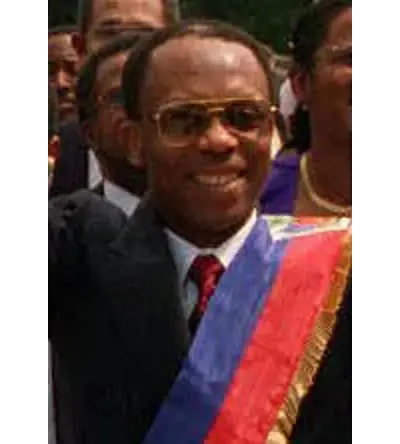
Jean-Bertrand Aristide is a Haitian former priest and politician who became Haiti's first democratically elected president. A proponent of liberation theology, Aristide was appointed to a Roman Catholic parish in Port-au-Prince in 1982 after completing his studies to become a priest of the Salesian order. He became a focal point for the pro-democracy movement first under Jean-Claude "Baby Doc" Duvalier and then under the military transition regime which followed. He won the Haitian general election between 1990 and 1991, with 67% of the vote. As a priest, he taught liberation theology and, as a president, he attempted to normalize Afro-Creole culture, including Vodou religion, in Haiti. President Aristide was briefly president of Haiti, until a September 1991 military coup. The coup regime collapsed in 1994 under U.S. pressure and threat of force (Operation Uphold Democracy). Aristide was then president again from 1994 to 1996 and from 2001 to 2004. However, Aristide was ousted in the 2004 coup d'état after right-wing ex-army paramilitaries invaded the country from across the Dominican border. Aristide and many others have alleged that the United States had a role in orchestrating the coup against him. Aristide was later forced into exile in the Central African Republic and South Africa. He finally returned to Haiti in 2011 after seven years in exile.
