Sandra Day O'Connor Quotes
I am against judicial reforms based on nakedly partisan reasoning.
Some Republican leaders, unhappy with some judicial decsions with which they did not agree, proposed measures from cutting judicial budgets to impeachment of judges.
Sandra Day O'Connor, U. S. Supreme Court Justice, Speech, Georgetown University, March 10, 2006
Sourced by: Eigen's Political and Historical Quotations

She was particularly critical of some of the current conservative politicians who were advocating retaliation against the judiciary because judicial decisions thwarted some of their fundamentalist preferences and preferred policies.


The government of Pakistan regarded this as seditious. The Government can fire judges at will and the military has the right to convene its own courts and try Pakistani civilians for certain alleged crimes by removing their cases from the civilian courts. Even when a Pakistani judge is not intimidated by the government or the military, the Islamic extremist fanatics often assassinate any public official who any one of thousands of fanatics feels is anti-Islamic.


Hatch was the chairman of the Senate Judiciary Committee at the time.


Jefferson’s fears were later reinforced by John Marshall in Marbury v. Madison {606468}


The highest court in New York.
The Least Dangerous Branch he used as the title of one of his books.

Then Clarence Thomas replaced Thurgood Marshall on the Supreme Court, there appeared to be a majority of the court that would overturn Roe v. Wade and a woman’s right to an abortion. However it was an election year and the Chief Justice, a Republican, was concerned that if Roe was overturned the electorate might take it out on the Republicans, whose Solicitor Generals had fought to overturn Roe, at the polls. He therefore postponed the hearing of a Pennsylvania case, and then tried to postpone it again till after the election. Blackmun’s memo caused a majority of the court to vote to hear the case with no additional delay. Ironically, by a single vote, Roe was upheld.

This was before the Iranian Revolution and the Government of the Shah was attempting to modernize and allow any Iranian citizen who was otherwise qualified to be judges including women and people of other religions.


This shameful quotation was shocking to most readers. It is subject to two interpretations: One that judges who did not rule on Constitutional issues the way conservative extremists wanted would come to physical harm. The other, that conservatives should pressure judges by withholding appropriations for the courts, impeachments and recall elections where they exist, as well as funding potential opponents for those jurisdictions where judges are elected. Both meanings were disgraceful in the view of most Americans. Later, DeLay was convicted and sentenced to jail for money laundering and illegally spending and raising campaign funds. He was also reprimanded by the House Ethics Committee for unethical methods of fund raising for other earlier actions.
He had been reporting from Egypt at the time. There was no judicial independence, and the judges were generally corrupt and incompetent. The system operated as a tradeoff. The government would not investigate and punish the corruption and bribery in the private cases if the judges would always rule for the government in the cases they brought. The system was particularly pernicious in that Egypt did not depend on the jury of peers system so the judges had great power in judicial proceedings.

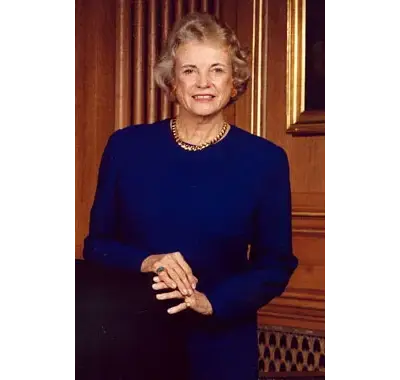
Sandra Day O'Connor is a retired attorney and politician who served as the first woman associate justice of the Supreme Court of the United States from 1981 to 2006. She was the first woman nominated and confirmed. Nominated by President Ronald Reagan, she was considered the swing vote for the Rehnquist Court and the beginning of the Roberts Court.
