Stephen Kinzer Quotes
Human Rights Watch wants Rwandans to be able to speak freely about their ethnic hatreds, and to allow political parties connected with the defeated genocide army to campaign freely for power.
Kinzer, Stephen. "Rwanda and the danger of human rights groups." The Guardian, Guardian News & Media, 31 Dec. 2010.


In a particularly acrimonious House debate on the largest military appropriations bill in the history of the country, the speaker limited an opponent to 45 seconds to argue against the pending bill. Jacobs shouted his protest:


From the latter part of the 20th century onward, religious nationalism was no longer a force for most religions and nations except Muslim countries. It was the only religion left where a large proportion of the adherents saw no distinction between the religion and the government. Nations that had separation of church and state were not conducive to the extreme fundamentalist form of Islam where the Secular Leader and the Religious leader was to be embodied as a single person. As a result Islamic religious nationalists argued for a Theocracy and at times fought for it with violent means. The secular government typically, to curtail the violence and prevent a religious takeover, often outlawed the extreme religious Islamic parties. While Aslan cites the Muslim Brotherhood failure in Egypt as a desirable outcome, the only way the other forces of Egyptian society could prevent the Islamists from taking over turning the country into a theocracy was to forcefully repress the extremists. The Turkish outcome was much better, but there was the threat of repression of the Justice and Development Party when it won a majority control of the government. There were explicit threats that if it tried to weaken the secular nature of the government as Ataturk had formulated it, the military would come “out of the barracks” and oust the government as they had done before. There were nations like China which persecuted religions such as certain forms of Christianity, but those religions were not fighting for religious nationalism. They only wished the freedom to practice their religion and had no program or theology that argued for Christianizing the government. The Tamil Hindus of Sri Lanka did not want a Hindu government and were perfectly free to practice their religion. The problem was that they felt that there was systemic social and economic discrimination against the Tamils and they fought for independence—not of a Hindu state, but of a secular, nondiscriminatory state of equal opportunity.


There had been a Ukrainian coup where the pro-Russian President of Ukraine was ousted and a new Parliament elected that was more inclined to Europe and the West. Unfortunately, several of the key members of the new regime were neo-Nazis. Ukraine had a nasty past where during WWII over 200.000 Ukrainians joined Hitler’s Nazis and fought against the 800,000 Ukrainians fighting with Russia and the Russians. The Ukrainians even ran the only death concentration camp no operated by Germans. Russia used the presence of some Nazis and the passage of the first Ukranian law of the new Parliament that prohibited the use of Russian in Ukrainian schools to come to the “aid” of the ethnic Russians living near the Russian border at the Eastern end of Ukraine who had seized the governments of several areas and forced the Ukrainian officials out and with the help of Russian “volunteers” with Russian weapons, prevented Ukrainian troops from reasserting control. In the struggle there were deaths on both sides of the conflict and these were the “peaceful civilians” who were “annihilated”.


Although nether he or the Sultan had made vigorous efforts to stop the massacres, he had promised the world community that Turkey would see that justice was done (See {620596} ). However, there were a few tried and one governor of a province was hanged and a few others received short jail sentences. Talaat, the worst of The Young Turks regarding the genocide, escaped to Germany. But he was tracked by a surviving Armenian who assassinated Talaat. The assassin was acquitted by a sympathetic German court which ruled that the extermination of the assassin’s family had been so traumatic that temporary insanity relieved the assassin of criminal responsibility.


The Iran President seemed to be irrational at times. He was also very hostile to democracies—none of which were acceptable to him. But he was the only leader of a member nation of the UN who ever called for the extermination of another UN member state. He called for the State of Israel to be “wiped off the map.”


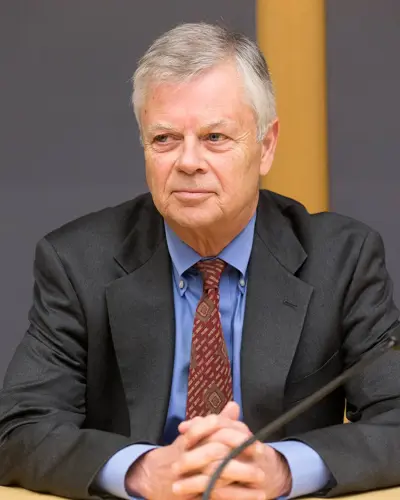
Stephen Kinzer is an American author, journalist and academic. A former New York Times correspondent, he has published several books, and writes for several newspapers and news agencies.
