William Pitt the Younger Quotes
How, sir! Is this enormous evil ever to be eradicated, if every nation is thus prudentially to wait till the concurrence of all the world shall have been obtained?
Elected at 24 as the youngest British Prime Minister. Many British proponents of the slave trade claimed that if they ceased the trade, then other countries like France would just swallow up all the business.
William Pitt, 1759-1806, British Prime Minister, Address to the Parliament, 1792
Sourced by: Eigen's Political and Historical Quotations


He did not personally deliver the speech in Stockholm as at the time he feared that if he left the Soviet Union he would not be allowed back in. So he wrote it, and it was read for him.


What was particularly interesting about this quotation is that Pinkney was a political leader of Maryland, a slave state. He saw the injustice and immorality of slavery but like many others of our founding fathers assumed that ending slavery would infringe on the property rights of the slave holders. Others argued that there can be no right to deny others their basic rights—property and wealth are subordinate to natural rights. See {632258} and {632259} for more on this point.


This call anticipated the formation of the United Nations.

Although Wedgwood was a business man and ceramic manufacturer, he was a staunch abolitionist. He made these medallions by the thousands and gave them to all who would receive them. The text became the motto of the anti-slavery society. It was one of the first examples of a logo – a symbol for a political cause being very effective.

This was the first success that the anti-slavery forces of England had—the recognition and official classification of slaves as humans. After that, it was easier to abolish the slave trade which occurred 16 years thereafter.

Duchess of Bedford. In 1853, during a visit to England, Harriet Beecher Stowe was presented with a petition containing the signatures of over a half million British women asking for an end to American Slavery. It was in 26 bound volumes. The backing of the prestigious Duchess and so many other English women had a profound effect on American Women and the growing strength of the Abolition movement.
One of the arguments against Negro emancipation from slavery was that they were not prepared for freedom. This famous quote countered that argument. Ironically, a similar argument was made years later with respect to Women’s Suffrage. It was argued that women first had to learn about voting and politics. This quotation was again used by the suffragettes long after Heyrick’s death.

As an entertainer she had toured much of the world and seen American slavery and that of some other nations. She became a staunch abolitionist and like entertainers in the 20th and 21st centuries she used her celebrity to give anti-slavery lectures and perform for audiences where she donated the proceeds of the event to the abolition cause. She is a particularly interesting political figure in that she seems to be one of the first entertainers to perform for a social cause and become an activist.

This quotation is fascinating and illustrates the depth and complexity of the problem facing Abraham Lincoln. Howell actually used the word “evil” to describe the abolitionists and their political efforts end slavery. He and other slave holders did not see slavery and the murder, brutality, and torture that went with it as evil. After the Presidential years of James Buchanan who protected the South from slavery reform and abolition as the North was gaining political power and the abolitionists were having a greater and greater effect on public opinion in the North. While Southerners did not believe Lincoln would emancipate the slaves, they realized that the majority of the growing nation was opposed to slavery, and more and more Northern states were passing laws making any slave who sets foot in the State a free person. Slaves could not only have more reason to run away, but slave owners would not be able to get their “property” back. Lincoln would not help the South as Buchanan did, and the Southerners realized that over time, slavery would no longer be feasible or profitable. Cobb, very experienced at Washington politics, realized the changes that would come and thought that they would be “certain and speedy.”—see {620555}. Lincoln had been elected a month earlier and without Buchanan as President to protect the institution of slavery, the anti-slavery majority of the country would prevail unless the South seceded. Cobb was one of the strong advocates. 6 days later, the Georgia legislature called for a convention to debate secession. The irony was that if the South had not seceded and simply dragged its feet legislatively, it would have taken two or three decades for slavery to end. However, by seceding and initially fighting so hard and well while weak Union generals were in command, Lincoln was forced to try more drastic measures and issued the Emancipation Proclamation after only a few years. The Civil War and secession was not only a tactical and strategic error for the South, but rapidly brought about just what the Southerners were fighting to prevent.

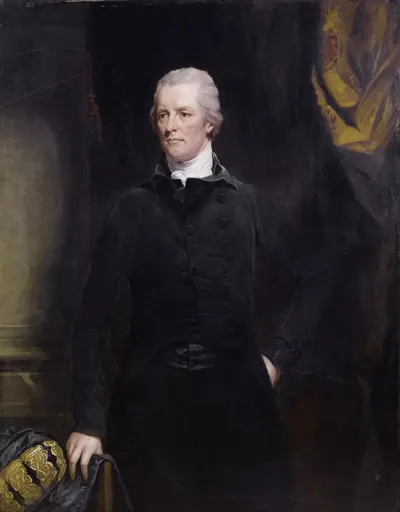
William Pitt the Younger was a prominent British Tory statesman of the late eighteenth and early nineteenth centuries. He became the youngest prime minister of Great Britain in 1783 at the age of 24 and the first prime minister of the United Kingdom of Great Britain and Ireland as of January 1801. He left office in March 1801, but served as prime minister again from 1804 until his death in 1806. He was also Chancellor of the Exchequer for all of his time as prime minister. He is known as "the Younger" to distinguish him from his father, William Pitt, 1st Earl of Chatham, who is customarily referred to as "William Pitt the Elder" (or less commonly, simply "Chatham") and had previously served as prime minister.
