Neil Armstrong Quotes
History will remember the twentieth century for two technological developments: atomic energy and space flight.
Hansen, James R. First Man: The Life of Neil A. Armstrong. Simon & Schuster, 2005.


Medaris then told him to do it in 90 days to give him some slack. 80 days later the U. S. put its first satellite in orbit with a Jupiter Rocket. There were scientists at the Jet Propulsion Laboratory who had been experimenting with rocket recovery, who realized that they had enough power and technique to escape the Earth’s gravity and put an object in orbit. The asked for permission to do so on their next weekly firing and were refused. Two months later, the Russians put Sputnick in orbit.

The letter was actually delivered to President Roosevelt on October 11. It was the stimulus for the Manhattan Project to develop the atomic bomb. It had been drafted in large part by physicist Leo Szilard whose idea it was that Einstein sign the letter. As the world’s most prestigious scientist Einstein, Szilard felt, would make more of an impression on FDR than he, Fermi or other scientists even though Einstein was a theoretician and never did work on the development of the bomb. The military men did not understand Szilard and thought him a danger to the nation. So the two men who initiated the idea of the development of an atom bomb did not do any, of the work on it.


Meitner and her nephew Frisch had been the first people to realize that the atom had been split. Meitner had described the process to her nephew and he made some drawings of the process she described. A few of these looked like a bacteria dividing. Frisch happened to meet with William A. Arnold, an American Biologist doing research in Stockholm. He asked Arnold what the biologists called it when a bacteria divided, and he replied, “fission”. Frisch told his aunt and she decided that they should use that term in the scientific article they were preparing on the splitting of the atom.

Morrison was then a graduate student of Oppenheimer. The quotation is important, not because it shows how quickly the “father of the atomic bomb” realized that a nuclear bomb could be made and how, but how relatively easy and rapid it was for a competent theoretical physicist could conceptually design a nuclear weapon if they first had knowledge of the Hahn / Strassmann Experiment and the Meitner / Frisch explanation of what had happened ({640924}). Note Leo Szilard’s letter at about the same time--{640925}.


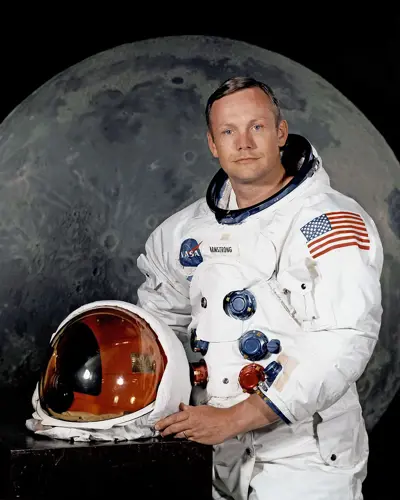
Neil Alden Armstrong was an American astronaut and aeronautical engineer, and the first person to walk on the Moon. He was also a naval aviator, test pilot, and university professor.
