John Quincy Adams Quotes
His tongue drips poison.
Referring to Senator John Randolph of Roanoke: See {631458} for an example of the kind of attack to which Adams reacted.
John Quincy Adams, 1767-1848, 6th President of the United States (Independent, MA), Quoted in McPhee, The Book of Insults, 1978
Sourced by: Eigen's Political and Historical Quotations

When the Republican leadership in 2008 stated that the Republican’s primary objective was to prevent the re-election of Barack Obama, it was not the first time that American politicians admitted that their major objective was to cripple an administration. This quotation shows a very early example. See {592642} for Adams view of Senator Randolph.


This is the earliest surviving attempt of the Romans to formulate a legal code.

For Tamil Indians the Tirukkural is sacred scripture. There is no archeological evidence of his existence—only his literature. The date therefore is very uncertain and might be as early as the 8th century BC or as late as the 2nd century BC.

_0_thumbnail_47x47.jpg "Statue of Robert Hall in Leicester.")


On the possibility of Jesse Jackson running for mayor of Washington DC with little administrative experience:

Both Buckley and Vidal were brilliant men and very accomplished debaters. However they were at opposite ends of the political and cultural spectrum and had a major dislike for each other. They were both intellectual elitists and snobs.


- Born: July 11, 1767
- Died: February 23, 1848
- Nationality: American
- Profession: President
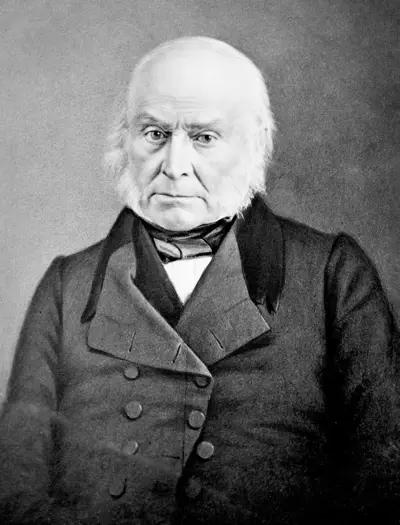
John Quincy Adams was an American statesman, diplomat, lawyer, and diarist who served as the sixth president of the United States, from 1825 to 1829. He previously served as the eighth United States Secretary of State from 1817 to 1825. During his long diplomatic and political career, Adams also served as an ambassador, and as a member of the United States Senate and House of Representatives representing Massachusetts. He was the eldest son of John Adams, who served as the second U.S. president from 1797 to 1801, and First Lady Abigail Adams. Initially a Federalist like his father, he won election to the presidency as a member of the Democratic-Republican Party, and in the mid-1830s became affiliated with the Whig Party.
