Thomas Aquinas Quotes
He (Mohammed) seduced the people by promises of carnal pleasure to which the concupiscence of the flesh urges us. His teaching also contained precepts that were in conformity with his promises, and he gave free rein to carnal pleasure. In all this, as is not unexpected; he was obeyed by carnal men. As for proofs of the truth of his doctrine, he brought forward only such as could be grasped by the natural ability of anyone with a very modest wisdom. Indeed, the truths that he taught he mingled with many fables and with doctrines of the greatest falsity.
Aquinas, Thomas. Summa Contra Gentiles, Book One: God. Translated by Anton C. Pegis, Hanover House, 1955, p. 73.


This is another of De Tocqueville’s prescient statements that in retrospect seem so amazing given the time. This quotation could serve as an op ed in a newspaper of any of the industrial democracies of the early 21st century. However, he did not have the information of the details we have today that showed Islam as the pinnacle of scientific, philosophical, literary and medical achievement at the beginning of the second millennium, while the Christian nations of Europe were mired in the Dark Ages. It was the same Koran but a very different interpretation and framework that led to the decadence while it was the Protestant Reformation that triggered a Christianity that was hospitable to modernity and enlightenment.


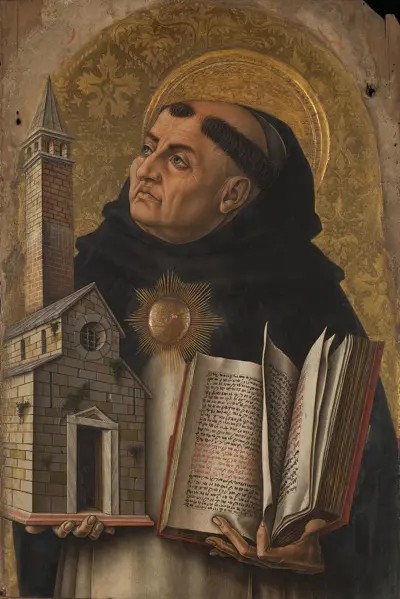
Thomas Aquinas was an Italian Dominican friar, philosopher, Catholic priest, and Doctor of the Church. An immensely influential philosopher, theologian, and jurist in the tradition of scholasticism, he is also known within the latter as the Doctor Angelicus, the Doctor Communis, and the Doctor Universalis. The name Aquinas identifies his ancestral origins in the county of Aquino in present-day Lazio, Italy. Among other things, he was a prominent proponent of natural theology and the father of a school of thought (encompassing both theology and philosophy) known as Thomism. He argued that God is the source of both the light of natural reason and the light of faith. His influence on Western thought is considerable, and much of modern philosophy developed or opposed his ideas, particularly in the areas of ethics, natural law, metaphysics, and political theory.
