Mary Todd Lincoln Quotes
He is a butcher, and is not fit to be at the head of an army.
Mary Todd Lincoln, 1818-1882, (Abraham Lincoln), Opinion of George B. McClellan, 1826-1885, General-in-Chief of the Union Army, Quoted in David Herbert Donald, Lincoln
Sourced by: Eigen's Political and Historical Quotations

During the Civil War, General Joseph Hooker castigated the President and called for a dictator to assume power:
When George B. McClellan was commander of the Union army, he maintained a very conservative military strategy and would not initiate any attacks. Lincoln wrote:
Hooker made some very poor decisions as far as Lincoln was concerned.

This has been a problem for not only Presidents and Governors, but all managers and administrators. When to terminate a subordinate who is not performing adequately. There is always the chance that the new appointee is no better or possibly even worse.
McClellan liked to parade and drill his troops but not fight them. Lincoln wanted him to take the offensive but the general always found an excuse not to. Many historians believe that McClellan wanted the war to end, the South to rejoin the Union and be allowed to maintain slavery. Others feel that he was just a military man who maintained his popularity by minimizing casualties. Finally, Lincoln fired McLellan and the complexion of the war changed thereafter. McClellan ran against Lincoln for the Presidency in 1864. See {633923}

See {615006} for but one example of terrible military money and procurement management.

While running for office he was trying to win the support of Republcian Conservatives who were very unhappyt with their percieved lack of progress in fighting ISIS. However, this was insulting to many military people--especiually since ISIS was being deprived of they sources of funding and oil trade, their leaders were being killed at a rapid rate, and they were losign most of their territory. After he won the Presidency, on the very night of his inaguration he then flip flopped and paraised the general leadship of the military. While most politicans had a certain degree of hypocricy, Trump could make totally contrdictory statements without any embarassment. See Quote 644331..


Adolphus W. Greely was an Arctic explorer whose party suffered enormous physical hardship in their search to find land north of Greenland. It was rumored that in order to survive, the party engaged in cannibalism of their already dead comrades. Greely was promoted to general to the dismay of some:


He had wanted more troops for the Afghan War than President Obama would approve. The Republican members of the Congress tried to make the difference a major issue of a President not supporting his commanders. The General made this brilliant response.

Changes were made and experienced preparedness professionals hired at the top, but with the change of the next administration the agency regressed backwards with a horseshow manager and attorney politically appointed as the head of the agency. After the FIASCO of FEMA’s performance with Hurricane Katrina, the head was fired from relief duties and then resigned.

McClellan found many reasons to avoid engaging the Southern forces, and when battles could not be avoided, he would never pursue the enemy after an engagement but would regroup. Much public opinion was unhappy with McClellan, but he had great support among the Democrats who were not supporters of the war. Finally Lincoln fired McClellan who then ran as a Democrat against the President in 1864. McClellan looked and talked like a great general but was much averse to fighting. Once rid of McClellan, the Union Army began to have success although losses on both sides were horrendous.

The President told McNamara that if the administration does not send the troops the Generals want, they will be blamed for any military failures that occur. If they do send all the troops that the Joint Chiefs wanted, they would be going far beyond the limits that the Defense Secretary recommended and the President would have preferred. JBJ felt he really had no political choice. He authorized the wanted troops further escalating the war. See his special assistant’s question about that decision in {617151}.


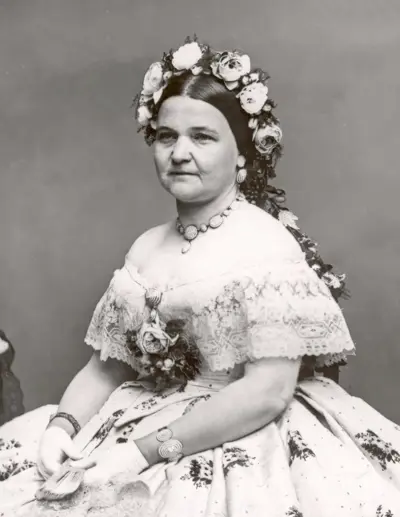
Mary Ann Lincoln was the wife of the 16th President of the United States, Abraham Lincoln, and as such the First Lady of the United States from 1861 to 1865. Today, she is commonly known as Mary Todd Lincoln, though she did not use the name Todd after marrying.
