Stephen Douglas Quotes
Having formed this new party for the benefit of deserters from Whiggery, and deserters from Democracy, and having laid down the Abolition platform which I have read, Lincoln now takes his stand and proclaims his Abolition doctrines
This was the first of the famous Lincoln-Douglas Debates. The men were contesting for the U. S. Senate. Douglas won the election. Lincoln was one of the new Republicans, a third party that had been formed by appealing to people who had been dissatisfied with either of the two major parties—the Whigs and the Democrats—and joined the new Party. Neither of the two traditional parties could just cope with .the national polarization caused by the slavery issue. They had “kicked the can down the road” until there was violence breaking out in Kansas and elsewhere.
Stephen Douglas, 1813-1861, U. S. Congressman & U. S. Senator (Democrat, IL), First Debate with Abraham Lincoln, Ottawa, Illinois, August 21, 1858
Sourced by: Eigen's Political and Historical Quotations


The President wanted Anderson to relay his message to other Republicans which he did. At that time the Southern racists were almost all members of the Southern bloc of the Democratic Party. Most Republicans were then advocates of non discrimination. By 2010 virtually all the racists, nativists, neo Nazis, anti Catholics, and anti Semites had gravitated to the Republican party if they were still active in politics. Reasonable Republicans were embarrassed as reasonable Democrats had been before the shift which resulted from passing the Civil Rights Act of 1964.


Ever since the beginning of the Republic, the major source of Federal revenue was customs duty from New York. The collector employed a massive bureaucracy and was then one of the largest patronage controller in the country. Thurlow Weed and other New York political bosses offered Abraham Lincoln their political support if Lincoln would give them control of the patronage. On September 5, 1864 Lincoln fired his man, Hiram Barney, and replaced him with Draper. The new collector promptly replaced key personnel down the line and stated publicly:


In the election of 1800, the Jeffersonian republicans were pitted against the John Adams Federalists. The latter had seen the revolution as against the excesses of England and King George and not necessarily against the notion of a class society where government served the interests of the upper class—a political battle that is still with us to some extent. The Jewish religion generally recognizes no right of theocratic authority of one man over others with all to follow the laws of God, was theologically very republican. Rabbis were teachers and had no theological or civil authority. To Nones and many other Jews the Jeffersonian ideals were very close to their religious and cultural tradition and to the extent that there has been a party of the classes and a party of the masses, most Jews had gravitated to the latter with the exception of merchants, bankers and others whose economic interests were with the right of center party.

This is one of the most idealistic and hopeful statements ever constructed by man. It was ironic that UNESCO which began with so much principle and hope became corrupt and even moved into the political arena taking positions on international disputes which was at odds with the Security Council.

One of their friends was then Judge Stephen Douglas who advocated equality for Mormons and appointed Mormons to various posts. Mormon support helped the Democrat’s Thomas L. Ford win the next gubernatorial race over his Whig opponent who was virulently anti-Mormon.

He succeeded to the extent that he was the driving force behind the British abolition of the Slave Trade.
The logic of Southern secession made so little sense to most Northerners, that they assumed that after the election, the Southern threats of treason and rebellion would stop. Most Northerners did not appreciate that Southerners had little economic vision absent slavery and could not imagine how they could survive. For the Northerners, they had seen great economic growth with free labor and no slavery. But most Southerners were ignorant of the possibilities except for the few very wealthy Southern families who had seen the North and England. They realized that the South could make it economically, but they whose total fortunes came from the ownership value of slaves, might not be in their exalted positions without slavery. At the time, the value of the Southern slaves was greater than the value of all the land, factories, mines, and farms of the South.
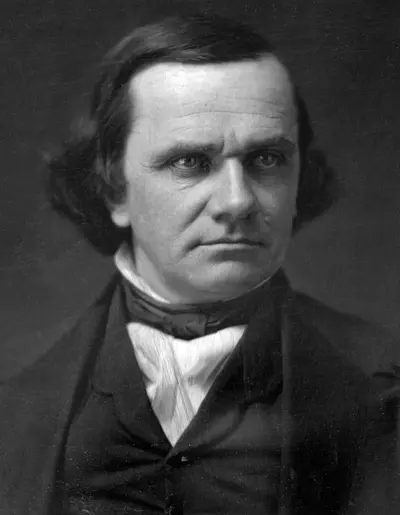
Stephen Arnold Douglas was an American politician and lawyer from Illinois. He was one of two Democratic Party nominees for president in the 1860 presidential election, which was won by Republican Abraham Lincoln. Douglas had previously defeated Lincoln in the 1858 United States Senate election in Illinois, known for the Lincoln–Douglas debates. During the 1850s, Douglas was one of the foremost advocates of popular sovereignty, which held that each territory should be allowed to determine whether to permit slavery within its borders. Douglas was nicknamed the "Little Giant" and "Stevie D" because he was short in physical stature but a forceful and dominant figure in politics.
