Peter Kropotkin Quotes
Governmental Communism … is repugnant to the worker.
Most Americans looked at anarchists as communists. They generally were not, and opposed state communism as much as state capitalism. In many ways they distrusted government the way some modern libertarians do.
Peter Kropotkin, 1842-1921, Russian Prince and Anarchist, Anarchism: Its Philosophy and Ideal, 1896
Sourced by: Eigen's Political and Historical Quotations

Sinclair had written an expose of the meat packing industry – the Jungle – which used as its setting the Armour meat packing factory. It changed the way the public thought about the industry, the role of government and regulation. President Roosevelt took up the reform role, and got Congress to Regulate the quality and cleanliness of the meat packing industry. Sinclair, however not only wanted that reform, but also wanted the labor wages and conditions reformed. He referred to the Armour plant as the fortress.

This was a very important quotation in that Sartre was a very influential liberal philosopher and when he condemned Russian communism, many other liberals opposed communism, and those who had already felt vindicated in their decision.


Comintern was upset by the American Socialist Party because the party had rejected the 21 Conditions for Affiliation and withdrew their intent to join the Third International. To Comintern, the Socialist Party was a party of “bourgeois socialism.”

3rd Earl Russell of Kingston. He favored and argued for a middle ground of a capitalistic socialism or a socialized capitalism, which is what most democracies became.


Ataturk was not receptive toward Communism as some other world leaders were at the time. He saw its weakness far earlier than many others.


This was a great victory for the Victor Berger wing of the party. They purged the violence advocates and communists from the party. Despite this, a few right wingers call any socialist a communist and a revolutionary.


The letter was widely published. There were few left wing intellectuals who would take Lenin on at the time but Gorter was one. The immediate quotation shredded a brochure that Lenin had produced for world wide communism where he was critical of other left wing movements.


Socialism in its then pure form had the state owning and controlling all the major assets of the nation. In this sense it was contradictory to individual freedom and hence democracy. However, in the years after Tocqueville’s quotation and the industrial revolution, socialism has gradually moved away from state ownership and operations of all institutions and resources. Democracy has tended to adopt a more regulatory view to control the excesses of unbridled capitalism. The range of democratic nations by the 21st century encompassed differences but some were described as “social democracies” and had some state ownership but were basically capitalistic economies. Even the self-described Communist nations had become heavily capitalistic albeit with less political freedom. At the same time, even the United States—the epitome of 21st century capitalism, owned and controlled a few of the resources and means of production and tended to regulate the others—a substantial difference from the American democracy which Tocqueville studied.

Unlike most of his televangelist successors, Sheen was very ecumenical. He was clearly Catholic but had a very significant Protestant and Jewish Audience.


The reason that this quotation is important is that most Americans from the 1920s on concerned with Marxism and communism in the United States, conflated Marxism with Anarchists as if Marxists were anarchists who were bent on violence. In reality, to most Marxists, anarchists were more their enemy than the capitalists. Stalin was then only 28 years old and the Russian revolution was 9 years in the future.

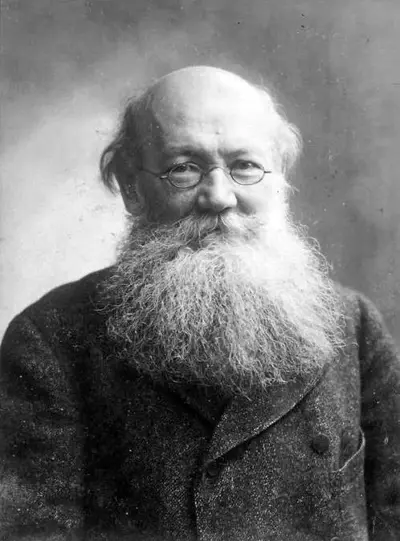
Pyotr Alexeyevich Kropotkin was a Russian anarchist, socialist, revolutionary, economist, sociologist, historian, zoologist, political scientist, human geographer and philosopher who advocated anarcho-communism. He was also an activist, essayist, researcher and writer.
