John C. Calhoun Quotes
Government is to divide the community into two great classes: one consisting of those who, in reality, pay the taxes and, of course, bear exclusively the burden of supporting the government; and the other, of those who are the recipients of their proceeds through disbursements, and who are, in fact, supported by the government; or, in fewer words, to divide it into tax payers and tax-consumers…. The effect, then, of every increase is to enrich and strengthen the one [the net tax-consumers], and to impoverish and weaken the other [the net tax-payers.
John C. Calhoun, 1782-1850, Vice President of the United States (Democrat, SC), U. S. Congressman & Senator (Democrat, SC), Disquisition on Government
Sourced by: Eigen's Political and Historical Quotations


For many years, the interest on home mortages have been deductible from Federal Income tax and most state income taxes. Originally, this tax subsidy was instituted to promote the idea of personal home ownership and help the real estate industry which has always had a great deal of political clout. See {634700}.


There are two reasons that government cannot depend on the rich for tax yield. First, there are very few rich compared to middle class workers. Although the rich person may pay more on the average in taxes, than others, there are not enough to cover all the expenses of a modern government. Second, because the rich make larger policitcal contributions and have lobbyists, they get legislation that exempts them from many taxes or provides loopholes. So even though the wealthy are theoretically supposed to pay a higher rate of taxes, as a practical matter, most wealthy people pay a lower tax rate than their secretaries or the waiter who will serve them lunch—the Buffet Principle.


This is the most articulate historical statement of the modern conservative mantra regarding taxes. However, one change has taken place. The words “necessarily” and “often” tend to be left out of the more modern ideological statements. Mellon’s original statement has never really had any politicians or economists who disagreed. Politicians of all economic persuasions have generally accepted the Mellon statement but the extreme conservatives’ creed is that a lowering of taxes always produces more revenue and a tax increase will inevitably lead to greater tax revenue—a position which Mellon never took. Mellon however was very solicitous of the wealthy, felt the welfare of the nation depended on their prosperity, and was a strong advocate of what was later called ‘trickle down’ economics {628592}.

FDR had as usual been attacked by the Chicago Tribune and other conservative newspapers. His assistant Raymond Moley drafted the response.


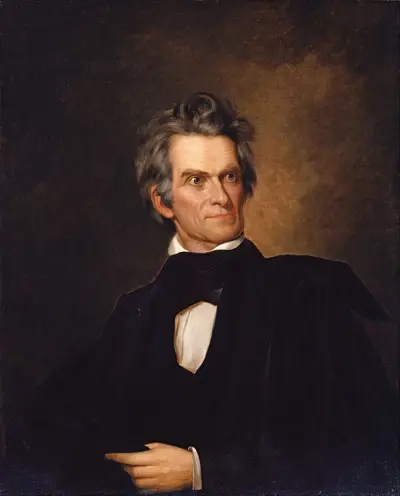
John Caldwell Calhoun was an American politician and political theorist from South Carolina who held many important positions including being the seventh vice president of the United States from 1825 to 1832, while adamantly defending slavery and protecting the interests of the white South when its residents were outnumbered by Northerners. He began his political career as a nationalist, modernizer, and proponent of a strong national government and protective tariffs. In the late 1820s, his views changed radically, and he became a leading proponent of states' rights, limited government, nullification, and opposition to high tariffs. He saw Northern acceptance of those policies as a condition of the South remaining in the Union. His beliefs and warnings heavily influenced the South's secession from the Union in 1860–1861.
