Isaac Newton Quotes
God who gave Animals self motion beyond our understanding is without doubt able to implant other principles of motion in bodies [which] we may understand as little. Some would readily grant this may be a Spiritual one; yet a mechanical one might be showne, did not I think it better to pass it by.
Newton, Isaac. Draft variant for Opticks, Cambridge University Library Add. MS 3970. Quoted in Westfall, Richard S., Never at Rest: A Biography of Isaac Newton, Cambridge University Press, 1980, p. 509.


This sura is interpreted by some Islamic fundamentalists as absolution for the killing of a non-Muslim by a Muslim. It was Allah who did it. In a greater sense, critics of Islam observe that many Muslims and Islamic nations have a double standard of responsibility for crimes. If the victims are Muslims, the normal standards of morality hold; but if a non-believer there can be no crime. Terrorism, torture, beheading, mass murder can all be done with a clean conscience if a Muslim takes this interpretation of this sura. Many Muslims however take an opposite point of view. These people do not have the concept of fatalism and lack of free will that others believe. There is a parallel to this problem in Judeo Christian countries although it is less common statistically. But the murder of physicians who perform abortions, and the Jewish radical fundamentalist who killed innocent Arabs at worship are examples of people who viewed themselves as instruments of God in their heinous activities.

Diversarum Hereseon Liber. This compendium of heresies would be funny but for the fact that people lived and died according to their “acceptance” of some of these absurdities.


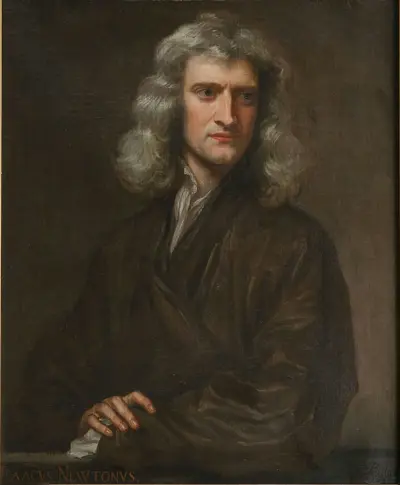
Sir Isaac Newton PRS was an English mathematician, physicist, astronomer, theologian, and author (described in his time as a "natural philosopher") who is widely recognised as one of the greatest mathematicians and most influential scientists of all time and as a key figure in the scientific revolution. His book Philosophiæ Naturalis Principia Mathematica (Mathematical Principles of Natural Philosophy), first published in 1687, established classical mechanics. Newton also made seminal contributions to optics, and shares credit with Gottfried Wilhelm Leibniz for developing the infinitesimal calculus.
