John Quincy Adams Quotes
From the day of the Declaration, the people of the North American union, and of its constituent states, were associated bodies of civilized men and Christians, in a state of nature, but not of anarchy.
Adams, John Quincy. The Jubilee of the Constitution. Samuel Colman, 1839, p. 16.


Anti-slavery opponents had cited the equality argument of the Declaration of Independence to buttress their argument.


He is wrong about his facts. At the time of the adoption of The Constitution, there were in the North some free Negroes who owned land and were able to vote—see Benjamin Banneker for one notable counter example. Another is Alexander Hamilton, one of whose parents were Black.


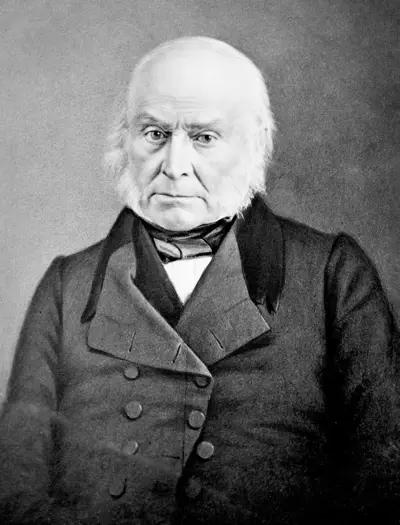
John Quincy Adams was an American statesman, diplomat, lawyer, and diarist who served as the sixth president of the United States, from 1825 to 1829. He previously served as the eighth United States Secretary of State from 1817 to 1825. During his long diplomatic and political career, Adams also served as an ambassador, and as a member of the United States Senate and House of Representatives representing Massachusetts. He was the eldest son of John Adams, who served as the second U.S. president from 1797 to 1801, and First Lady Abigail Adams. Initially a Federalist like his father, he won election to the presidency as a member of the Democratic-Republican Party, and in the mid-1830s became affiliated with the Whig Party.
