Miyamoto Musashi Quotes
From inside fortifications, the gun has no equal among weapons. It is the supreme weapon on the field before the ranks clash, but once swords are crossed the gun becomes useless.
Musashi, Miyamoto. A Book of Five Rings: The Classic Guide to Strategy. Translated by Victor Harris, The Overlook Press, 1974, p. 46.


General Shafter had a major attack of Gout, a terribly painful disease for which there was little relief at the time. As a result he had little involvement in the battle of Santiago at the most critical period. Crassus was an incompetent general in a famous Roman battle.

Churchill saw before many others that technology and weaponry had changed the nature of warfare. At the time the military leadership of all the major powers were pursuing 19th century tactics with 20th century weaponry including mass bayonet charges against machine guns behind barbed wire. Churchill and other civilians, although they had legal control over the military, had little de facto tactical control. As a politician he became an itinerant meddler in military tactics thereafter.


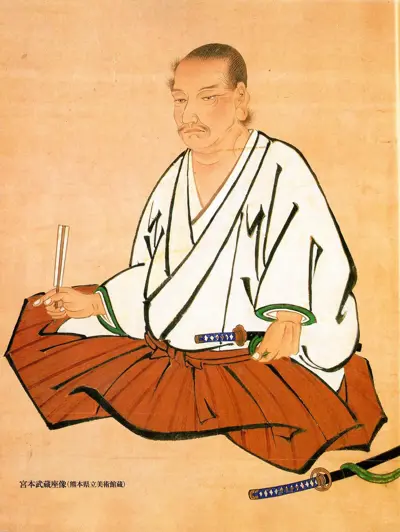
Miyamoto Musashi, also known as Shinmen Takezō, Miyamoto Bennosuke or, by his Buddhist name, Niten Dōraku, was a Japanese swordsman, philosopher, strategist, writer and rōnin. Musashi, as he was often simply known, became renowned through stories of his unique double-bladed swordsmanship and undefeated record in his 61 duels (next is 33 by Itō Ittōsai). He is considered a Kensei, a sword-saint of Japan. He was the founder of the Niten Ichi-ryū, or Nito Ichi-ryū, style of swordsmanship, and in his final years authored The Book of Five Rings (五輪の書, Go Rin No Sho) and Dokkōdō (The Path of Aloneness). Both documents were given to Terao Magonojō, the most important of Musashi's students, seven days before Musashi's death. The Book of Five Rings deals primarily with the character of his Niten Ichi-ryū school in a concrete sense, i.e., his own practical martial art and its generic significance; The Path of Aloneness, on the other hand, deals with the ideas that lie behind it, as well as his life's philosophy in a few short aphoristic sentences. The Miyamoto Musashi Budokan training centre, located in Ōhara-chō (Mimasaka), Okayama prefecture, Japan was erected to honor his name and legend.
