Spiro Agnew Quotes
Freedom of speech is useless without freedom of thought. And I fear that the politics of protest is shutting out the process of thought, so necessary to rational discussion. We are faced with the Ten Commandments of Protest:
Thou Shalt Not Allow Thy Opponent to Speak.
Thou Shalt Not Set Forth a Program of Thine Own.
Thou Shalt Not Trust Anybody Over Thirty.
Thou Shalt Not Honor Thy Father or Thy Mother.
Thou Shalt Not Heed the Lessons of History.
Thou Shalt Not Write Anything Longer than a Slogan.
Thou Shalt Not Present a Negotiable Demand.
Thou Shalt Not Accept Any Establishment Idea.
Thou Shalt Not Revere Any but Totalitarian Heroes.
Thou Shalt Not Ask Forgiveness for Thy Transgressions, Rather Thou Shalt Demand Amnesty for Them.
There were ongoing protests over the Vietnam war in many universities throughout the country. Agnew and some others thought that protests and demonstrations were not an appropriate method of maintaining a national discussion on the subject.
Spiro T. Agnew, 1818-1996, Vice President of the United States (Republican, MD), speech to governors and their families, Washington, D.C., December 3, 1969; “Collected Speeches of Spiro Agnew,” pp. 98–99 (1971).
Sourced by: Eigen's Political and Historical Quotations

He and 8 others were executed by the military dictatorship which controlled Nigeria. It was led by General Sani Abacha who was the chief “goon” to whom he was referring. His observation is a fundamental of protest activities in countries of high illiteracy. Printed literature is relatively impotent in an oral, illiterate country. But “literature in the streets” is the oral protest of large groups of people. Because he was so effective at organizing this, he was executed on trumped up charges and his body hidden from his followers and relatives. See {586598} and {586596}.

Hirsh had uncovered CIA illegal surveillance of anti Vietnam war protesters in the late 1960s. They broke two sets of laws. First, the CIA had no authority to investigate and track American Citizens anywhere but particularly American citizens. Second, the FBI which did have the authority to investigate Americans, were not allowed to use the methods that the CIA did. They violated not only Federal Law and Rules, but also violated the 4th Amendment Rights of thousands of citizens.

In November of each year protesters gather at Fort Benning, the site of the U. S. Army School of the Americas. The School provides training for Latin American Military Officers in Counter-Insurgency Training. The graduates of the school have included some of the worst Latin American killers and torturers (See {41061} for example) who rose to positions of power in their lands. It has also included many leaders who did not ever resort to war crimes and atrocities and also became leaders of their countries. It has been an institution of great controversy since it was discovered that the school at one point taught methods of interrogating insurgents that were tantamount to torture. Defenders of the school claim that but for the school, the military atrocities would have been worse and that it contributed to more human and democratic governments in the Americas. The annual protest has attracted more than 16,000 protesters, some of whom—like Bourgeois—have been guilty of trespass and interfering with a government facility and have served jail terms for those violations.


He was arguing that the government should be able to prohibit public demonstrations on the grounds that the protesters are “irresponsible power.” This position has been taken sometimes by the American right, and is common in all totalitarian states.


Lowery was one of the senior Black leaders in the civil rights movement of the late 1950s and early 1960s. In this interview, he was describing the atmosphere in Mobile, Alabama. Clergy of most faiths were active in the Civil Rights Movement in the South with the exception of the Roman Catholic Church which was very institutionally conservative. The Catholic leaders had a problem in that Catholics had been heavily discriminated against in early America and this prejudice was heaviest in the South in the 20th century. They feared that Catholic Activism against the status quo would create more problems for Catholics so they were not very helpful or supportive. This was NOT true for Catholics in general. Many individual Roman Catholics marched in the demonstrations, and some Catholic clergy from outside of the South came to the Southern protests and demonstrations. In the 20th century, the Catholic Church was divided between social activist reformers and in some cases revolutionists and the conservative wing of the Church who had supported the status quo.

J. Edgar Hoover, the racist FBI Director, and the Chief of Police of the all white Washington DC Police Force, had made phone calls and sent memos to as many important people they could reach, warning that there was bound to be violence if 100,00 militant Blacks tried to march on Washington. There were twice that number planned for by Bayard Rustin, the man in charge of the March planning, but 250,000 showed up. There were very few incidents and no injuries and deaths as a result of some brilliant planning by Rustin and the cooperation of Attorney General Robert F. Kennedy—the President’s brother—with Rustin. However, the fear spread by Hoover and others caused the major league baseball games to be cancelled, liquor stores to be closed, stores and offices throughout the city were intimidated and closed. But it was one of the best organized and peaceful social/political demonstrations in history.

The president was surprised by the rapid spread and expansion of the anti-war movement at the time was convinced that the communists were organizing the effort. After all the investigations and histories, it was an extremely fast growing movement—perhaps the first of the digital political movements as e-mail was one of the tools used in the universities where e-mail was then coming into use.

Armenia has no tradition for freedom of speech and assembly, and little respect for Human Rights. This quotation illustrates what many of our American lawmakers were concerned with when they prohibited the military from being used domestically against civilians. When a national Guard Unit is called up, the Pentagon no longer controls the soldier but the State Governor and his State National Guard Commander have the command and control.

As a result was in 1799 he was indicted, convicted, and fined $480 and sentenced to 18 months in jail. In 1801, newly elected President Thomas Jefferson pardoned Brown along with all violators of the act.

He was sentenced to life in prison for his advocating Violence if the Uighurs would not be given their independence. They were then the 2nd largest Muslim group in China.

The rate and intensity of the anti-nuclear power movement in Japan had slowed somewhat from the peak after the meltdown and catatostrope of Fuklishima. Professor Nakano was asked if this meant the end of popular social action regarding nuclear popwer.


A bomb threat was received and cell phones might be used to detonate a bomb by remote control. However, no one in the vicinity of the BART system could use their cell phones for ANY purpose. The cell phone had begun to be a major tool of protesters organizing demonstration, and many people were concerned that the police might decide that an impending demonstration was a danger to public safety and prevent demonstrators from organizing or coordinating using mobile phones. Civil libertarians argued that the police should have to get a court order and show probably cause in order to shut down a public communications system.

The State Police then attacked the demonstrators with night sticks, bull whips and tear gas. The demonstrators were trying to cross the bridge to Montgomery. There was no legal Constitutional way that the marchers could be stopped, but the Alabama State Police then constantly violated the law.


Shortly after, he backed off the notion of having a bloodbath removing protesting students.
In some universities would sometimes protest the selection of a commencement speaker and demonstrate. On some of these occasions the school administration withdrew the invitation. In addition to the problem described by Beckel, the university sells out its basic intellectual commitment to hear all ideas and points of view—regardless of how repugnant or evil. Commencement speakers tend to create a bigger problem because of the custom of the university granting the speaker an Honorary Degree. Whereas it is against the academic tradition to censor a speaker and having a speaker does NOT associate the University, the faculty or the students with the views of the speaker. But the granting of the Honorary Degree does imply an institutional approval and admiration of the speaker, and that is fair game for student protest. However in the beginning of the 21st century some extreme left wing students succeeded in intimidating spineless university administrators and trustees into censoring speech and the ideas of the speaker. This was typical behavior of the right wing brownshirts of the 1930s when it was the Fascists who were prohibiting certain speakers—usually left wingers. 80 years later it was the left wing extremists engaging in this undemocratic behavior.

Although he had majority support, he reacted very badly to anyone who challenged him or his party about anything. One of his decisions to transform a park into a shopping center drew crowds of peaceful protesters. He grossly overacted as he believed in a “winner take all” view of democracy. So long as he could bring more followers than the protesters, he was right and they were wrong. This had the effect of polarizing a population that had been a democracy since the 1920s. In his view, dialogue, discussion, and debate are not valuable processes, and minority views can never be correct, but whoever can muster the majority gets to call the shots and make all the laws and decisions, regardless of the views of minorities.

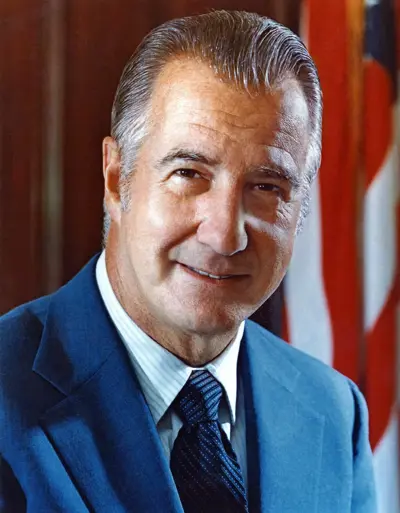
Spiro Theodore Agnew was the 39th vice president of the United States, serving from 1969 until his resignation in 1973. He is the second and most recent vice president to resign the position, the other being John C. Calhoun in 1832. Unlike Calhoun, Agnew resigned as a result of a scandal.
