Paul Robeson Quotes
Four hundred million in India, and millions everywhere, have told you, precisely, that the colored people are not going to die for anybody: they are going to die for their independence.
United States, Congress, House, Committee on Un-American Activities. Investigation of the Unauthorized Use of U.S. Passports—Part 3. Government Printing Office, 1956, p. 4500.


Nguyen Ai Quoc was early pseudonym.

In 1937 the U. S. Treasury Department commissioned a pair of large murals to decorate the lobby or the Ariel Rios Federal Building in Washington DC. On the mural was depicted a U. S. Mail Service from Alaska to Puerto Rico. It showed four Puerto Rican women reading a letter in the Inuit dialect presumably delivered from Alaska. The authorities loved the mural until they discovered the translation of the Inuit letter. This was a direct reference to the Puerto Rican Nationalist Independence Movement. That year 18 Puerto Rican Nationalists were killed and over 100 wounded when police fired into a crowd of demonstrators on March 21. Kent, a famous artist, planted a newspaper story with the translation and soon media all over the company were drawing attention to the Puerto Rican movement, just as Kent had intended.


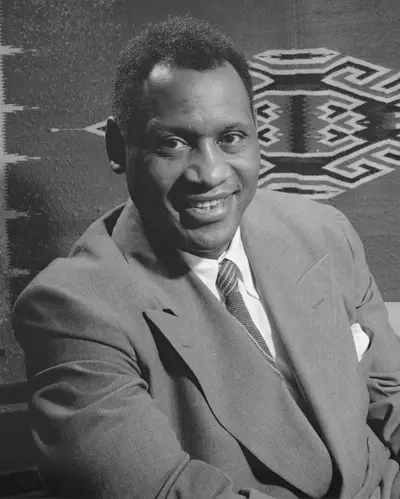
Paul Leroy Robeson was an American bass baritone concert artist and stage and film actor who became famous both for his cultural accomplishments and for his political activism. Educated at Rutgers College and Columbia University, he was a star athlete in his youth. He also studied Swahili and phonetics at the School of Oriental and African Studies in London in 1934. His political activities began with his involvement with unemployed workers and anti-imperialist students whom he met in Britain and continued with support for the Republican cause in the Spanish Civil War and his opposition to fascism. In the United States he became active in the Civil Rights Movement and other social justice campaigns. His sympathies for the Soviet Union and for communism, and his criticism of the United States government and its foreign policies, caused him to be blacklisted during the McCarthy era.
