John F. Kennedy Quotes
For if Freedom and Communism were to compete for mans allegiance in a world at peace, I would look to the future with ever increasing confidence.
Kennedy, John F. "Address at the University of Washington, Seattle, November 16, 1961." Public Papers of the Presidents of the United States: John F. Kennedy, 1961, U.S. Government Printing Office, 1962, p. 727.


The veracity depends on how one defines a democracy. Serbia attacked Croatia and Bosnia—all fledgling democracies. Argentina, claiming to be a democracy, attacked England by invading the Falkland Islands. Hitler was elected in Germany in a free and fair election, and once they started their aggressive war Germany became a Fascist Dictatorship. What appears to be the case is that stable industrial democracies never make war on each other.


3rd Earl Russell of Kingston. He favored and argued for a middle ground of a capitalistic socialism or a socialized capitalism, which is what most democracies became.

Socialism in its then pure form had the state owning and controlling all the major assets of the nation. In this sense it was contradictory to individual freedom and hence democracy. However, in the years after Tocqueville’s quotation and the industrial revolution, socialism has gradually moved away from state ownership and operations of all institutions and resources. Democracy has tended to adopt a more regulatory view to control the excesses of unbridled capitalism. The range of democratic nations by the 21st century encompassed differences but some were described as “social democracies” and had some state ownership but were basically capitalistic economies. Even the self-described Communist nations had become heavily capitalistic albeit with less political freedom. At the same time, even the United States—the epitome of 21st century capitalism, owned and controlled a few of the resources and means of production and tended to regulate the others—a substantial difference from the American democracy which Tocqueville studied.

The Red Scare had already reached most conservatives and Truman and most others had not yet been affected by the fear of Communism that so many people had through the 1970s.
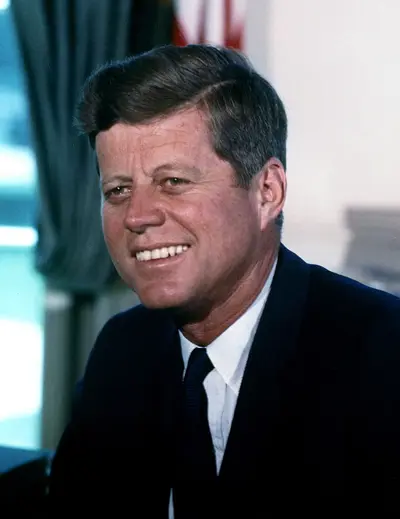
John Fitzgerald Kennedy, often referred to by his initials JFK, was an American politician who served as the 35th president of the United States from 1961 until his assassination in 1963. Kennedy served at the height of the Cold War, and the majority of his work as president concerned relations with the Soviet Union and Cuba. A Democrat, Kennedy represented Massachusetts in both houses of the U.S. Congress prior to becoming president.
