Winfield Scott Quotes
Fire-arms are very liable to be damaged, or rendered unfit for service, as a consequence of military routines. To prevent such damage, not a screw nor a pipe will be moved by the soldier, without express permission from the proper authority,” with the tools for such tasks kept by the sergeants. If there be an armorer present, he alone will be entrusted to repair weapons, no matter how minor the task... guns will be cleaned after rain or even if left out in a morning dew. Guns shall not be left in the care of privates, but collected and stored under guard every night.
This quotation is particularly interesting because it belies the image of America as a society where almost everyone was familiar with guns and firearms—that we had a gun culture. In reality most Americans from Colonial times on, could not afford guns and many that could afford them preferred other weapons for defense due to the lack of reliability of firearms. Guns were always a status symbol however. This quotation shows that most American soldiers did not know how to properly care for guns even in fundamental ways and could not be trusted to care for them much less repair them—a far cry from the image of the American rifleman alone in the first with his trusty weapon with which he was familiar and skilled.
Winfield Scott, 1786-1866, Commanding General, U. S. Army, Order on Infantry Tactics, 1925
Sourced by: Eigen's Political and Historical Quotations

This is yet another quotation demonstrating that the image of early America as a gun culture where most men were armed, skilled with those arms, and ready to come to the defense of the country. It turns out that none of the three corresponded to any historical reality for most Americans.


The National Rifle Association was Founded by men who were distressed that young men from the cities were so unskilled with firearms when the served in the Civil War that they thought that there should be an organization devoted to teaching the skilled use of firearms in case of another war. Frederick, the President, was himself a skilled marksman having won several of the shooting events in the Olympics. The officers and the organization in the early days and received free ammunition from the Federal Government with which to train and certify young men in shooting accuracy. The organization, alarmed at the high rage of gun accidents causing death and serious injury added gun safety to their program and this was followed by teaching and certifying Hunting Safety as well. Their vision was that marksmanship and safety through their courses and programs would be implemented by schools, camps, scouts, clubs and other intermediary organizations which were certified by the NRA.

This quotation is often provided by historians studying the gun culture of America. Even conservatives like Ames did not see a gun or an armed citizenry as important to America’s survival or well being. Contrary to popular belief, even the State Militias’ whose rights to bear arms was written into the Second Amendment did not bother to do so. In 1803 only three state militias had rifle companies. Firearms of the time were expensive, difficult to maintain, and hard to use. Unless one needed them for defense, it was too much of a bother. Even in the aftermath of the War of 1812 only 30% of Massachusetts adult men owned guns; by 1839, the rate was below 10%. It was on the frontier where guns were popular and necessary. See {613080}.
Even though the research was done by the U. S. CDC (Communicable Disease Center), the finest public health research center in the world, it was still attacked by the National Rifle Association and many of their supporters in Congress. The response was so intense that in the appropriations for the CDC there was an amendment that required that Federal Money not be spent for “Gun Safety Research”. So Federal Health Agencies were actually barred by Congress from doing any research as to how guns can be used, stored and manufactured more safely.


She advocated armed self-defense for Blacks.
He was unhappy about the fact that the Royal Canadian Mounted Police were still routinely carrying guns on duty. In England and Canada there has been a tradition of police officers on their beats being unarmed. When more force is needed special armed police are dispatched.


The Factory had been established by the State of Virginia in 1775 to make guns. America filled with armed Americans in the Colonial era was a myth. Early America was not a gun culture. Guns were expensive, needed maintenance, took too long to reload, and were not as effective for most purposes as other weapons like hatchets and knives. American Colonial war was mostly hand to hand combat with relatively little shooting. Less than one fourth of the men joining Washington’s army owned guns. Gun factories could not survive for want of customers and gunsmiths went into other occupations. See {613052}. With the rebellion, it was critical to manufacture guns to arm the soldiers who had not their own. But the efforts like this were relatively feeble. The factory director who made not a single gun in over a year was then promoted to Commissary General of Munitions in the Continental Army. He was married to George Washington’s sister. He did however finance much of the munitions he procured with his own personal funds so made up in wealth and patriotism what he lacked in manufacturing skill.

This is historically a very important quotation. It shows that gun control was existant in Colonial America. The violation of the gun laws were so serious that the Connecticut Council itself heard and tried the case and it was not even handled by the constable. On the same day, they also fined Bartholomew Barnardt for allowing his son to shoot a militia musket in his possession. Today, most states would not be allowed much gun control as politically there is a belief that in Colonial America gun use and ownership was almost universal. That assertion appears to be untrue. See {613056} and {613057}.

This quotation is referred to by these who debunk the myth that everyone was armed in early America. This was so on the frontier where there were potential Indian hostilities but in the rest of the country guns were not a part of everyday life or the culture. Even hunting was not that common an activity as raising cattle and farming was a much more reliable method of assuring a good food supply. The quotation is also often referred to in discussions regarding preparedness. This was an early example where the effect of peace and quiet was to diminish government budgetary commitment to military preparedness. . Floyd was very modern in his economic views, so much so that he, even as a Southern politician, opposed slavery on the grounds that it was economically inefficient and the South would never develop industrially if it had no incentive, as existed in the North and England, to reduce the amount of labor required for economic opportunity. He was right on that point as well.

Even allowing for a certain amount of exaggeration, it is clear that there were many Americans who were personally armed in this period.

There were very few people who believed that a pistol would have no defensive value then and there are very few today. The advocates of gun control grant its defensive value, but argue that the rise of using a gun is greater than the benefit of the use. Add to that the deaths from suicides and gun accidents which kill more Americans than those who are shot and killed intentionally.

Although written by a science fiction writer, this is one of the best quotations arguing for widespread gun ownership.
Gunsmiths were few in early America and a skilled gunsmith could only make about 3 per month. As a result guns in early America were a luxury and few Americans orned them. This is contrary to the myth that the early Americans were all gun owners and sharpshooters.
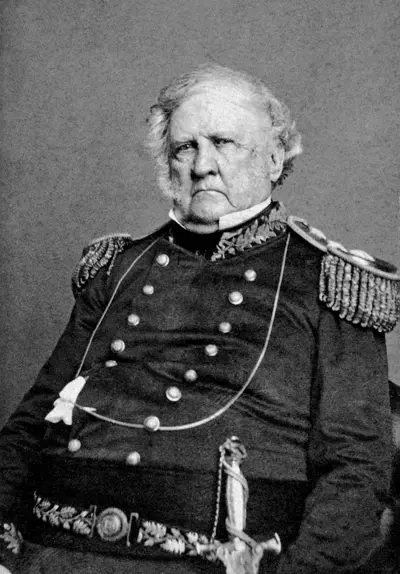
Winfield Scott was an American military commander and political candidate. He served as a general in the United States Army from 1814 to 1861, taking part in the War of 1812, the Mexican–American War, the early stages of the American Civil War and conflicts with Native Americans. Scott was the Whig Party's presidential nominee in the 1852 election, but was defeated by Democrat Franklin Pierce. He was known as Old Fuss and Feathers for his insistence on proper military etiquette, as well as the Grand Old Man of the Army for his many years of service.
