Louis D. Brandeis Quotes
Experience should teach us to be most on our guard to protect liberty when the government’s purposes are beneficent…the greatest dangers to liberty lurk in insidious encroachment by men of zeal, well meaning but without understanding.
See {620694} for a related idea.
Louis D. Brandeis, 1856-1941, U. S. Supreme Court Justice, 1928
Sourced by: Eigen's Political and Historical Quotations

He was referring to governments that imposed some form of morality in their citizens. Free governments do no dictate a morality and require their citizens to follow it. He was very much opposed to Prohibition which he saw as a poor government—Herbert Hoover’s Administration—which was imposing its narrow morality on all. He was very suspicious of government actions where the government claimed that the action was for moral objectives. This is a classic Libertarian view. In general, it is Fundamentalists and ideologues who want to impose their particular morality on all. See {620693} for a related idea.


At that time, ideology was not a driving political force and individual politicians often were hard to classify. For example, Humphrey was at the far left—an ultra liberal. Yet he was a staunch advocate of the right to bear arms. 50 years later there were no liberals who did not want to restrict gun ownership, And at that time, many Republicans were advocates of gun control, an unheard of situation in the 21st century beginning.

The "administrative state" was the term used for a government had had powers and used them to regulate things and areas of society without each specific regulation being voted upon by the legislature. In America sicne the New Deal there have been so many areas that have regulations that a single agency like the Environmental Protection Agency might issue in a year more regulations than the entire Congress considers in all areas put together. All these regulatory powers are delegated by Congress passing legislation authorizing it, and Congress can legislate any change in any regulation it wants, but the modern state is so complesx and areas so specialzied that Congress has preferred to delegate. There are a few who legal scholars and politicians who believe that it is unconstitutional for the legislature to delegate powers to the executive branch and no regulations have validity unless specifically passed by Comgress. There are some others who have not taken a position on this point but who believe that of an administrative state can regulate phases of citizens lives it is bound to circumscribe personal freedom as all legislation does to some extent. This quotation was used by opponents of Judge Gorsuch in arguing that he was unfit for the Supreme Court as he was out of touch with the Administrative State which America gradually became and rapidly in the New Deal and in the 80 years thereafter a very extensive administrative state. Gorsuch's views were based on classic political pholosophy but there were some ultra conservatives who did not want any regulation of business by Congress or Administrative Agencies and therefore supported Gorsuch and the few others with this view as if Agencies were not able to issue regulations there was no practical way that Congress could issue as many and regulation would be reduced which is what they desired.


Samuel Langhorne Clemens, 1835-1910. Although very much a liberal, Twain had little use for socialism on the grounds that it interfered with the independence of the individual. State religion was to him another form of state socialism.


This view causes great problems for Republicans and Tea Party members in that they share this and a few other particular views with the race haters like Lane. Many tend to conflate the viewpoints—especially when KKK and Aryan Nation members show up at Tea Party Rallies. Also, the extreme hyperbolic rhetoric. Someone who disagrees supports “tyranny” and is not a fellow citizen.


The Jury Trial was part of New York Law more than a century before the Constitution.

His political view was one of general opposition to Government—especially large Government. However, even the Conservative voters whose nomination he sought did not elect him to any public position. His inherited fortune allowed him to run for office and campaign.
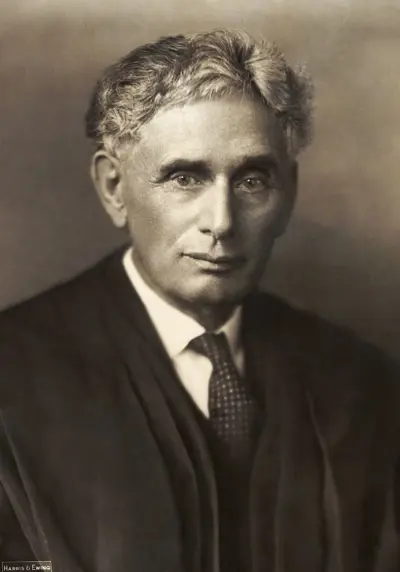
- Born: November 13, 1856
- Died: October 5, 1941
- Nationality: American
- Profession: Judge
Louis Dembitz Brandeis was an American lawyer and associate justice on the Supreme Court of the United States from 1916 to 1939. He was born in Louisville, Kentucky, to Jewish immigrant parents from Bohemia (now in the Czech Republic), who raised him in a secular home. He attended Harvard Law School, graduating at the age of 20 with the highest grade point average in the law school's history. Brandeis settled in Boston, where he founded a law firm (that is still in practice today as Nutter McClennen & Fish) and became a recognized lawyer through his work on progressive social causes.
