Woodrow Wilson Quotes
Every people has a right to choose the sovereignty under which they shall live.
Wilson, Woodrow. "A League for Peace." Address to the United States Senate, 22 Jan. 1917. The Papers of Woodrow Wilson, edited by Arthur S. Link, vol. 40, Princeton University Press, 1982, p. 536.


While this has been one of the great American principles of political philosophy, in reality we have on many occasions interfered when a people chose an enemy of the United States or made a choice of a government which would seize power and not allow any further free choices. However, from the time JFK made this statement to today, our foreign policy record has become much better on implementing this principle.


The United States was opposed to elections at the beginning of the Vietnam war. The Viet Min, the Russian and Chinese recognized government of Ho Chi Min, was extremely well organized as a result of their cohesive organization and victory over the French Colonialists. At the urging of the French, we supported the previous Vietnam Emperor who the French had supported. However his popularity was limited to Saigon and French Colonial centers. The majority of the population saw him as the collaborator who was propped up by the hated French. There was no way that the Communist Viet Min would lose in an election. There had been no time for the people to see what peacetime living under the communists was like, and what they knew of the Emperor, they did not like. It was important to keep Vietnam from falling into the hands of the Communists. Once they won one election they would control the machinery of government to be sure that they won all subsequent elections even if the people wanted a change in government. The German newspaper thought that we should stick to our principles and allow a free election and live with the consequences. In retrospect, we would be where we ended up anyway with the Communist Viet Min in totalitarian control of the country and we would have saved many lives and much money.


The Muslim Brotherhood which had been elected after the Arab Sprint deposition of President Mubarak, had then begun to institute their own religious philosophy into what was becoming a theocratic government. Rights of Christians, and other non-Muslims as well as moderate Muslims, together with women, democrats and advocates for human rights and freedom were trampled. 30 million people demonstrated in the streets and the nation was about to have a civil war when the military, under el-Sisi, deposed the Muslim Brotherhood government. When the Brotherhood took to the streets, many with weapons, there was a clash where almost 1000 Brothers were killed as were almost 100 police. The general was addressing the Egyptians and the rest of the world explaining the reason for breaking up the demonstrations.


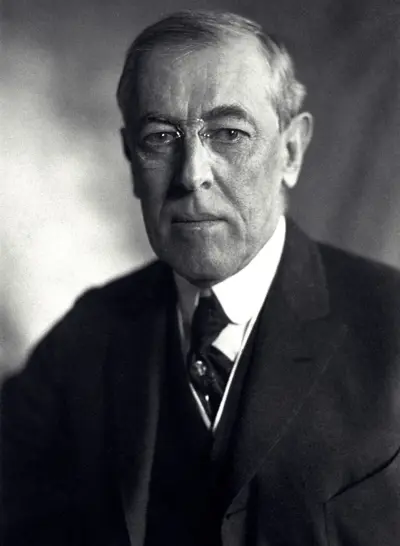
Thomas Woodrow Wilson was an American politician and academic who served as the 28th president of the United States from 1913 to 1921. A member of the Democratic Party, Wilson served as the president of Princeton University and as the 34th governor of New Jersey before winning the 1912 presidential election. As President, Wilson led the United States into World War I in 1917. He was the leading architect of the League of Nations, and his progressive stance on foreign policy came to be known as Wilsonianism. Scholars have generally ranked Wilson in the upper tier of U.S presidents, although he has been criticized for supporting racial segregation and white supremacy.
