Albert Einstein Quotes
Every intellectual who is called before one of the committees ought to refuse to testify.
Referring to the loyalty hearings that were being held by congressional investigating committees:
Albert Einstein, 1879-1955, Nobel Laureate in Physics, Letter to New York Times, June 12, 1953
Sourced by: Eigen's Political and Historical Quotations


The editorial was in response to Congressional hearings held by J. Parnell Thomas of the House Un-American Activities Committee whereby Hollywood producers and directors were questioned about their political beliefs.

Seeger had been a member of the Communist Party and had left it in 1950. See {635866}. He was later called before the House UnAmerican Activities Committee and asked to reveal the names of others who had been members. In those days of the red scare and McCarthyism, most people asked to name names and not wanting to do so “took the 5th Amendment” and could not be legally forced to reveal the names. Seeger as a matter of principle refused to plead the 5th Amendment because he was not afraid of incriminating himself and had done nothing criminal anyway. So he, a war veteran of WWII, instead refused to answer citing his First Amendment right of freedom of association. There was no legal precedent for this, and he was indicted and convicted for Contempt of Congress. However, his conviction was overturned as unconstitutional by the U. S. Federal Appeals court. Seeger had prevailed legally. But in retaliation Seeger was blacklisted and none of the radio of TV networks or Hollywood Studios would allow him (and other blacklisted artists) to appear. See {642545} Today most Americans view what McCarthy, The Congressional Committee, the networks, and Hollywood studios had done as contemptible.


The Red Scare had affected the country. The House Un-American Activities Committee had frightened much of the country claiming that the Communists had infiltrated the government. But when facts and proof were demanded, they only came up with some workers in the Hollywood film industry who had gone to communist meetings and some who had joined the party before the War when The Great Depression was still plaguing the country. The Hollywood and TV executives caved in to the political demagogues and fired and blacklisted not only the communists but those who refused to testify. The actors and musicians could not work for several years until the country came to its senses, but the screenwriters wrote under false names. At least one Academy award was won that way.
The Red Scare had affected much of the country. The House Un-American Activities Committee had frightened much of the country claiming that the Communists had infiltrated the government. But when facts and proof were demanded, all they came up with some workers in the Hollywood film industry who had gone to communist meetings and some who had joined the party before the War when The Great Depression was still plaguing the country. The Hollywood and TV executives caved in to the political demagogues and fired and blacklisted not only the communists but those who refused to testify. The actors and musicians could not work for several years until the country came to its senses, but the screenwriters wrote under false names. At least one Academy award was won that way.


The actor refused to cooperate with the House Un-American Activities Committee investigations into alleged communist activity and was blacklisted by the move industry for over a decade. See {588677} and {588759}.

A theater arts program that operated nationally under the WPA.

Jones constantly told King and other associates that the FBI was tapping their telephone conversations. Senator Joseph McCarthy was a right wing paranoid who imagined communists throughout the government. Jones turned out to be right. During that period, the height of the Civil Rights Movement, the FBI was listening, recording, and transcribing, every single phone call to or from King including the conference calls and calls with his attorney. FBI Director received frequent briefings on what King and his associates were doing. Although he ordered the wiretaps, it was Robert F. Kennedy, then the Attorney General, who had to approve them.

Bruce is one of the few American Comedians to so offend the political establishment that he was constantly legally harassed throughout his career. He was actually criminally convicted in New York for obscenity. In 2003 he was posthumously pardoned by the New York Governor, the first posthumous pardon in state history.
Seeger had been a member of the Communist Party and had left it in 1950. See {635866}. He was later called before the House UnAmerican Activities Committee and asked to reveal the names of others who had been members. In those days of the red scare and McCarthyism, most people asked to name names and not wanting to do so “took the 5th Amendment” and could not be legally forced to reveal the names. Seeger as a matter of principle refused to plead the 5th Amendment because he was not afraid of incriminating himself and had done nothing criminal anyway. So he, a war veteran of WWII, instead refused to answer {635867} citing his First Amendment right of freedom of association. There was no legal precedent for this, and he was indicted and convicted for Contempt of Congress. However, his conviction was overturned as unconstitutional by the U. S. Federal Appeals court. Seeger had prevailed legally. But in retaliation Seeger was blacklisted and none of the radio of TV networks or Hollywood Studios would allow him (and other blacklisted artists) to appear. Today most Americans view what McCarthy, The Congressional Committee, the networks, and Hollywood studios had done as contemptible.

Written after the Stanford law student protest of a Federal Court of Appeals judge (Stuart Kyle Duncan) who was invited to speak at the university.


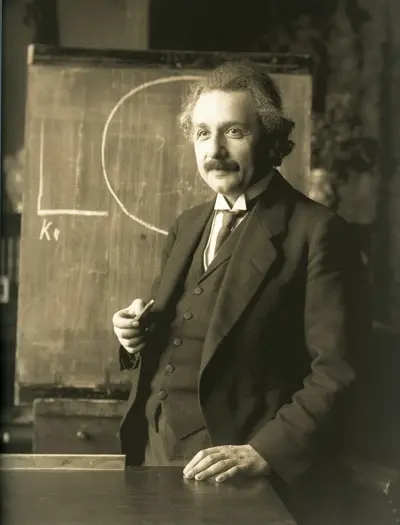
Albert Einstein was a German-born theoretical physicist, widely acknowledged to be one of the greatest physicists of all time. Einstein is known for developing the theory of relativity, but he also made important contributions to the development of the theory of quantum mechanics. Relativity and quantum mechanics are together the two pillars of modern physics. His mass–energy equivalence formula E = mc2, which arises from relativity theory, has been dubbed "the world's most famous equation". His work is also known for its influence on the philosophy of science. He received the 1921 Nobel Prize in Physics "for his services to theoretical physics, and especially for his discovery of the law of the photoelectric effect", a pivotal step in the development of quantum theory. His intellectual achievements and originality resulted in "Einstein" becoming synonymous with "genius".
