Aristotle Quotes
Every effort therefore must be made to perpetuate prosperity. And, since that is to the advantage of the rich as well as the poor, all that accrues from the revenues should be collected into a single fund and distributed in block grants to those in need, if possible in lump sums large enough for the acquisition of a small piece of land, but if not, enough to start a business, or work in agriculture. And if that cannot be done for all, the distribution might be by tribes or some other division each in turn.
Aristotle. Politics. Translated by H. Rackham, Harvard University Press, 1932, Book VI, ch. 5.


The Depression had 25% unemployment and many people lacked even food to eat. Meanwhile, there was a huge amount of unused, idle land in California.


At the time of this quotation, the nation had gone through more than 3 decades of enormous increase in prosperity for the wealthy, and modest gains for the highly skilled, technically trained workers. However, correcting for inflation, average salaries did not increase at all. The middle class was particularly hard hit. Only 20 percent of the population benefitted from the growth at all; however, the 1 percent had rarely prospered more. Kenworthy’s principle did not apply for this period of American history.


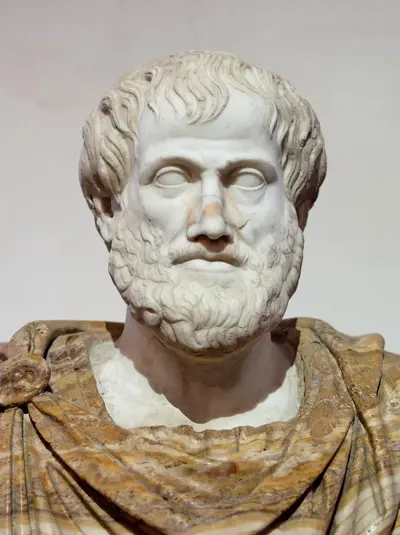
Aristotle (/ærɪˈstɒtəl/; Greek: Ἀριστοτέλης Aristotélēs, pronounced [aristotélɛːs]; 384–322 BC) was a Greek philosopher and polymath during the Classical period in Ancient Greece. Taught by Plato, he was the founder of the Lyceum, the Peripatetic school of philosophy, and the Aristotelian tradition. His writings cover many subjects including physics, biology, zoology, metaphysics, logic, ethics, aesthetics, poetry, theatre, music, rhetoric, psychology, linguistics, economics, politics, meteorology, geology and government. Aristotle provided a complex synthesis of the various philosophies existing prior to him. It was above all from his teachings that the West inherited its intellectual lexicon, as well as problems and methods of inquiry. As a result, his philosophy has exerted a unique influence on almost every form of knowledge in the West and it continues to be a subject of contemporary philosophical discussion.
