Charles Lindbergh Quotes
Even if America entered the war, it is improbable that the Allied armies could invade Europe and overwhelm the Axis powers. But one thing is certain. If England can draw this country into the war, she can shift to our shoulders a large portion of the responsibility for waging it and for paying its cost.
Lindbergh, Charles A. "Our Relationship with Europe." America First Committee Rally, Soldier Field, Chicago, IL, 4 Aug. 1940.

Lindbergh, a great aviator, was a Fascist who like most of the America Firsters was a great admirer and supporter of Hitler and Mussolini. The British and the Jews were by no means unified in favor of war but the majority of each group was. The British had theor Fasscists including the Duke of Windsor who was pressured to abdicate. There were even some Jews who thought that Hitler was an aberation and the German people would never follow him. But the American right wing extremists were adamant that the United States should not enter the war. Even after the Japanese sneak attack on Pearl Harbor and the German Declaration of War against the United States many of the


American official foreign policy had been officially isolationist—to not get involved in the squabbles and fights of other nations. Angell however pointed out that even before WWII, America had formally been involved in 6 foreign wars and used military incursions on foreign soil on almost 100 occasions.

The State Department and the Defense Department often clash over power and control of various foreign policy activities and initiatives. Whereas secrecy is supposed to be a means of keeping critical information from the enemy, it is very frequently used to cover-up embarrassment and also to prevent a rival government agency from registering objections to ongoing programs. In the latter case the secret classification has two advantages for the agency wanting to maintain their autonomy. First, they keep the information from the rival agency for a while. Eventually, the other agency has people with secret clearance who will find out, but because the material is secret they cannot publicly discuss the wisdom of the policy of initiate a public debate.


Then Navy Assistant Secretary Roosevelt had just seen photos of Samuel P. Langley's early attempts at manned flight.


There were some British politicians who had considered the possibility of supporting the South in the Civil War to assure their supply of cheap cotton. Entering the war by allying with the Confederacy was also a possibility. Lincoln used this phrase and instructed Adams to use that with the British politicians as the result if England get involved with the American Civil war. It is the closest phrase to “World War” until WWI.

Before American entry into the War with Japan, Chiang Kai-shek and the Soongs maintained that they were fighting the Japanese but it was not generally true. They were fighting Mao and his Communists while Mao was fighting the Japanese. By 1942, under pressure from the United States and Russia, the Nationalists and Communists agreed to a truce so that they could both fight against Japan. Based on the promises made to President Roosevelt by Madam Chiang, the Soongs, and Chiang himself, there was an expectation of extensive military attacks against the Japanese. The U. S. then sent a large amount of military aid to Chiang Kai-shek, but there did not appear to be any significant attacks against the Japanese other than those mounted by the Communists. Magruder, General Marshall’s emissary to Chiang Kai-shek was instructed to investigate. When the war ended, Chiang Kai-shek used the assets he was saving in to attack Mao and his communists just as he had done before the truce. Magruder had been right. However, just as Chiang could not defeat the militarily inferior Communists before the truce, he could not do so after. Soon Mao turned the tables and drove Chiang Kai-shek and his Nationalists out of Mainland China. President Roosevelt had brilliantly judged the ability of England, Russia, and Yugoslavia to fight the Germans, but as this quotation and {641677} shows, he listened to the wrong people. He had been sold a “bill of goods” by the China Lobby, the Soongs and Chiang Kai-shek.


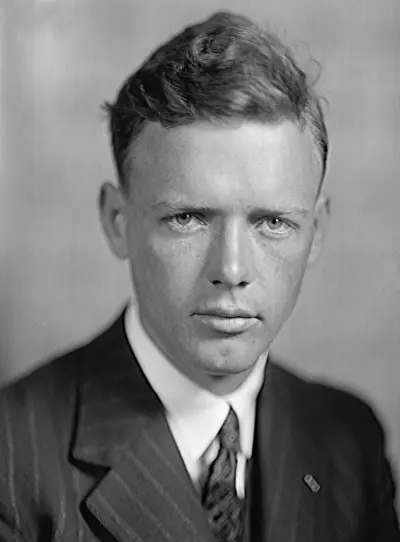
Charles Augustus Lindbergh, nicknamed Slim, Lucky Lindy, and The Lone Eagle, was an American aviator, author, inventor, military officer, explorer, and social activist. In 1927, at the age of 25, Lindbergh emerged from the virtual obscurity of a U.S. Air Mail pilot to instantaneous world fame as the result of his Orteig Prize-winning solo nonstop flight from Roosevelt Field on Long Island, New York, to Le Bourget Field in Paris, France. He flew the distance of nearly 3,600 statute miles (5,800 km) in a single-seat, single-engine, purpose-built Ryan monoplane, Spirit of St. Louis. Lindbergh was the 19th person to make a Transatlantic flight, the first being the Transatlantic flight of Alcock and Brown from Newfoundland in 1919, but Lindbergh's flight was almost twice the distance. The record-setting flight took 33 1⁄2 hours. Lindbergh, a U.S. Army Air Corps Reserve officer, was also awarded the nation's highest military decoration, the Medal of Honor, for his historic exploit. Politically, the National Hero became an active fascist supporter of Mussolini and Adolph Hitler who awarded him a Medal for Supporting Fascism, Anti-Semitism and advocating for America to allow Hitler to conquer German and the rest of Europe. After WWII he was in disgrace.
