Bernie Sanders Quotes
Establishing a 0.03 percent Wall Street speculation fee, similar to what we had from 1914-1966, would dampen the dangerous level of speculation and gambling on Wall Street, encourage the financial sector to invest in the productive economy and reduce the deficit by more than $350 billion over 10 years.
Sanders, Bernie. "Deficit Reduction That Makes Sense." HuffPost, 19 Nov. 2012.

Keynes was suggesting a small transfer tax on securities and other financial instruments. For investors, such a tax would not be a significant burden, but it would discourage pure speculation. Generally every one likes that idea except the speculators. They in turn, play off one nation or jurisdiction against the others by threatening to take their stock and bond markets to other nations which do not have such a tax. That has worked for almost a century in avoiding such a tax in the United States which is the center for both world investment and speculation.

The States sold bonds to finance the their efforts in the Revolutionary War. Some states had better prospects for redeeming their bonds than others. Georgia, South Carolina and North Carolina in particular had poorer prospects than most and their bonds were selling at about 25 cents on the dollar. Alexander Hamilton, then the Secretary of the Treasury, wanted the new Federal government to assume the state’s war debt and pay off the bonds. He made his proposal for how he would accomplish this on January 14, 1790. He delivered his report and proposal to Congress “Report on the Public Credit”. As soon as Hamilton’s proposal was read in Congress, sophisticated speculators set off for the Southern States to buy up as many bonds as they could before the owners found out that a Federal bail-out was under serious consideration. They could easily double, triple or even quadruple their money. Many congressmen wanted to outlaw the speculation. See {619929} & {619939}. The pro-speculation forces got their way. Some speculators made fortunes. Most bondholders lost money.

While the majority of the country approve of a financial transaction tax on the stock market, the financial industry has always fought it tooth and nail. It was a long tradition that the Barons and leading aristocrats lands were exempt from the taxes of the king, the most powerful forces in a democracy have lobbied to avoid taxation on their enterprises and finance is one of the very few business areas that have avoided taxation in America. Other than not liking taxes in general, Wall Street and the Banks argue that many financial transactions involve buying and selling securities in huge volume and making a tiny percentage on each share. If there were a tax of even a fraction of one percent, all these profitable trades would become unprofitable. Critics argue that that kind of speculating does not help the economy at all, and is what makes the discriminatory, unfair, computer trading possible and it would be a good reform to make that kind of trading unprofitable as more than 99 percent of the people cannot participate in it nor profit from it.


Addressing Theodore Roosevelt in 1896:

The first of these safeguards was abandoned during the George W. Bush administration and the economic meltdown of 2008 resulted. The Obama administration in 2010 restored some regulation of banks and investment banks.

Arguably, for most of American History, most of the “smartest” people contributed to manufacturing, construction, research and development—activities that produce things that are wanted and/or needed. However, Wall Street began attracting and paying for some of the smartest people in the society, who when they engaged in finance—not only contributed less to manufacturing, but began to create highly complex financial instruments and procedures that few people could understand and with which regulators have difficulty understanding. These and the other schemes of financing have been major factors in the economic problems that have beset the economy including the meltdown of 2008 and the subsequent Great Rescission.

This was a typical argument in the 2012 battle between President Obama and the Republican conservatives. However, this was written 35 years earlier, when the exact same issue was polarizing politicians. The idea for taxing the rich more to reduce the deficit has been around since there was a Federal deficit. On most occasions the rich had enough political clout to avoid additional taxes for them and get the general public to pay instead of them. However, there have been times where they have not been able to avoid increased taxes. The New Deal lead by Franklin Delano Roosevelt and the Obama administration in 2013 were two such exceptions.

The President, like most Americans, was outraged at the immoral, insensitive, and incompetent behavior of the financial industry in the Meltdown of 2008. However, the President learned how dependent the economy of the entire country was dependent on having solvent banks and how vulnerable the entire nation was to major failures of the investment and regular banks. So he was faced with very poor options. The government could have nationalized the banks, but that would produce an economic system which in the long run would not be very sound. Of the banks could be allowed to fail or risk failure in which case the entire population would suffer. Or he could lend money to the banks to stabilize and strengthen them while the bank executives were paying themselves huge bonuses even though they performed so poorly. He chose the latter and Warren was typical of criticism he received from many of his supporters. Even though the banks had broken the law and forged documents and committed perjury in tens of thousands of mortgage foreclosures, the President, as a practical matter, could not even prosecute the bank officials who were responsible because there were thousands of bank and other company officials who had committed the same crime. The guilty included almost every senior officer of the major banks, and jailing all these people was deemed impractical. So, to recover the economy, justice and fairness suffered.
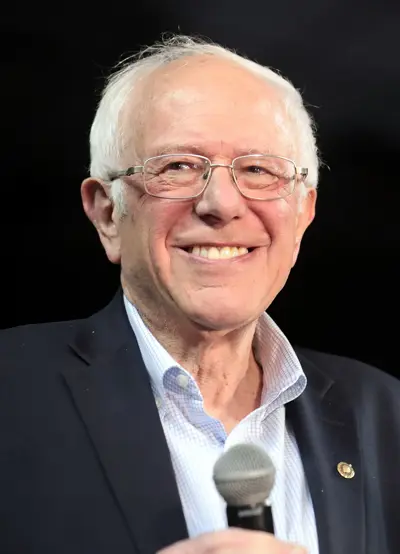
Bernard Sanders is an American politician who has served as the junior United States senator from Vermont since 2007 and as U.S. Representative for the state's at-large congressional district from 1991 to 2007. He is the longest-serving independent in U.S. congressional history, although he has a close relationship with the Democratic Party, having caucused with House and Senate Democrats for most of his congressional career. Sanders unsuccessfully sought the Democratic Party nomination for president of the United States in 2016 and 2020, finishing in second place in both campaigns. Before his election to Congress, he was mayor of Burlington, Vermont.
